
Recycling Center Stays Open
The fate of the Custer County Recycling Center has been a source of discussion and a little contention for the past few months as the Board of Supervisors tries to determine how to resolve the financial woes of the facility.
Last December, the commissioners voted to continue funding the center through June 2026. The issue was revisited at the board’s meeting on Tuesday, June 23, as a larger-than-usual crowd packed into the county board room. At the heart of the conversation surrounding the center has been the budget; more specifically, whether or not out-of-county users are paying enough to justify their use of the facility.
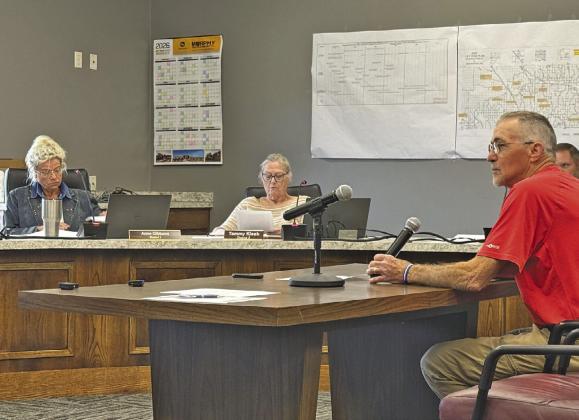
After the board had reviewed and discussed the costs and fees associated with the center, the floor was opened up for public comment. Several residents from across the county took advantage of the opportunity to share their thoughts, including Callaway Village Board members Mark Kimball and Lawrence Paulsen.
“If it’s a situation where the communities need to help shoulder it, we’re willing for it, but we want a lot more transparency and understanding in how it all works,” Mark Kimball said, as quoted by KCNI/ KBBN Radio. “You guys are in charge of quite a little bit of money, and there’s a number of people that you have to answer to, their budgets and stuff too. But to just pull the plug on this and to go ahead and let them get what they want, I don’t think that’s right. That’s not serving the constituents of this county justice.”
Kimball added that he believes the recycling center is very important for the residents of Callaway who send a lot of cardboard to the facility. He asked the supervisors not to rush into a decision on the center, saying, “That’s not serving the constituents of Custer County.”
Paulsen, owner of Callaway Market, shared with the board that the recycling center has saved the Village of Callaway a significant amount of money, particularly in the recycling of cardboard. He said he attended the meeting out of curiosity as to how cardboard would be handled should the center close.
“Obviously, I am one of the large contributors to that problem with our volume of cardboard, so I need to know if I didn’t have a place to go with it what I was going to do,” said Paulsen in an interview with the Courier. “The Village would have to provide me with two or three more dumpsters, which is not really feasible at all for us to throw cardboard in the dumpsters and expect the Village to haul it off. They would have to haul it twice a week.”
Paulsen explained that there used to be cardboard dumpsters in Callaway that the Village would haul to Lexington, but that was quite
Cont. PAGE 3: Recycling expensive. “The recycling center not only saves us a lot of trips down the road, they also provide a lot larger receptacle,” he explained. “It was frustrating for me to learn that other counties are using our landfill and not paying their fair share. Nobody wants to see their taxes go up or the cost of living go up, but our cost of living will definitely go up if they close the recycling center. Our trash rates will have to take a bump again for the Village to take care of the cardboard problem.
I think splitting the costs among all the communities in our county on a per capita basis would be a good thing, and somebody needs to look at it.”
Paulsen said without the recycling center, he would have to look at possibly purchasing a cardboard compactor, which is very expensive, or piling it on pallets, for which a forklift would be required. “So I would be looking at a significant investment,” he said. “Or I could just haul it down to the burn pit and burn it, which is not a good solution.”
Following several public comments, the Board of Supervisors voted on a motion to keep the recycling center open through the lease date with Myers Construction of February 2028. Two board members, Anne Gibbens and Lynn Longmore, voted against the motion, which passed 4-2. In an interview with Longmore a few days following the meeting, he explained why he voted against the motion.
“I believe the number that was shared with us was that 18 percent of the county’s people live in rural areas and the rest are in towns, and I think that most towns have a budget for their trash removal. My thought was that the county should be paying for 18 percent of the recycling and the towns should be paying for the rest,” Longmore explained. “Then the town boards can decide if their constituents want recycling or not. That’s up to them.”
Though it really has no bearing on the issue currently at hand, Longmore said he has never agreed with the decision by the county board back in the early 1990s to rent a building for recycling. “There is no other county in the state of Nebraska that does what we do as far as recycling. Most of the towns take that on,” he added.
Longmore said he is a proponent of recycling, and even obtained a grant for a recycling truck for Callaway when he worked for the Village. He said the Village discontinued use of the truck when they began partnering with the Custer County Recycling Center.
He sees the solution to the issue as a joint effort.
“My thought is that all the towns get together and the county commissioners and decide what they want to do. Where the towns have the population, I think it’s up to them. I don’t see the county heading this up,” said Longmore. “If Oconto, for example, doesn’t want to recycle, that’s up to them. Recycling is expensive.
People are very passionate about it, and I am too. I’ve just never felt it was the commissioner's job to push recycling down people’s throats if they don’t want it.” Though the motion to keep the center open for the remainder of the current contract passed, the conversation is far from over. For now, the county has until February 2028 to decide how to proceed with the recycling issue.