

Studying The Snakes of Nebraska – Even Invisible Ones

Everyone who knows me knows that I love snakes.
I always have, and I always will. I can’t remember my first snake, but it was probably a plains garter snake.
Since then I have kept bull snakes, racers, hognose snakes as well as a number of different kinds of garter snakes. I’ve had tree boas, red tailed boas, ball pythons and a reticulated python, and yes, I have kept rattlesnakes. I wrote a graduate thesis about snakes.
My last snake was a large female bull snake that I had for over 10 years. However, when she passed away, Cindy said that was it! She had lived for 50 years with a snake or two or five in the house. She said enough is enough.
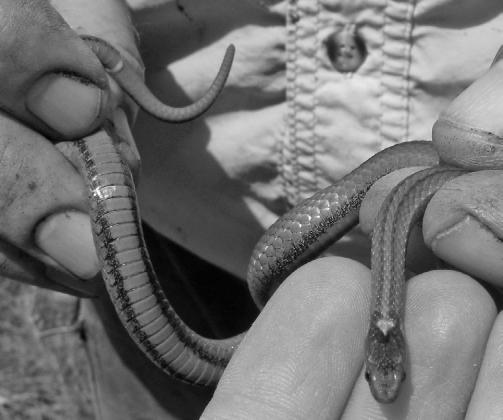
What got me to thinking about snakes this morning was a text and a photo from my brother-in-law in Lincoln asking me if I knew what kind of snake this was.
It was a DeKay’s brownsnake. They are very common in eastern Nebraska and he was amazed that after living in Lincoln for 50 years he had never seen one. He isn’t alone. The snake is named after naturalist James Ellsworth DeKay. The scientific name is Storeria dekayi with the genus name, Storeria, coming from a friend of DeKay’s by the name of David Humphreys Storer.
These are small snakes rarely growing more than a foot long. They are retiring, non-venomous snakes that live in the leaf litter under trees. They are almost invisible.
These snakes are a perfect example of the old adage that “absence of proof is not proof of absence”. It is also true of a snake we have around here. This snake is the “first cousin” of the DeKay’s brownsnake, the red-bellied snake, scientific name Storeria occipitomaculata… or the Storeria snake with the white spots on the side of its head.
Back when I was doing my research on reptiles and amphibians, I conferred with other biologists and the consensus was that the three rarest snakes in Nebraska were the black-headed snake, the smooth green snake, and the rarest of all…the red-bellied snake.
No work on reptiles in Nebraska had been done between 1940 and 1986 when I started my research. At that time there were only two verified collections of red-bellied snakes in Nebraska. After talking with Dr.
John Lynch, from the University of Nebraska-Lincoln, I was told that if I ever found any of the three rare snakes in my surveys to call him immediately.
Well, as you would guess, a month later I caught three red-bellied snakes just south of Gothenburg. I called Dr. Lynch and he drove out that day! He took the snakes back to Lincoln with him so that he could photograph them and study them. Those were the first, but they were far from the last. I learned how to find the little buggers and a year later when I published my thesis the red-bellied snake was the second most common snake that I collected with only plains garter snakes being more common.
Red-bellied snakes come out of hibernation in the spring, mate, and then the female gives live birth to four to eight young in late August. They are extremely hard to keep in captivity because live slugs are their favorite food. Like the DeKay’s brownsnake they are small, blend in with their environment, and they live under the tall grass along the river where the humidity allows for slugs. Are there any here in town? I don’t know, but out along the river, from North Platte to Aurora, I can assure you they are “thick”, just invisible!