

Hometown Husker: Credit Is Due
Jared Crick, a Star in His Own Right, Played in Suh’s Shadow
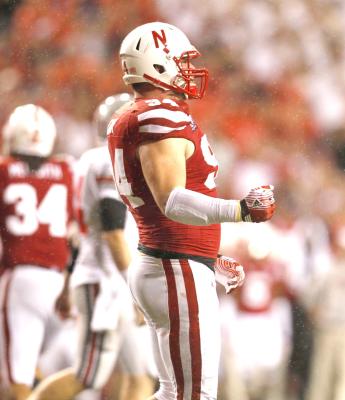
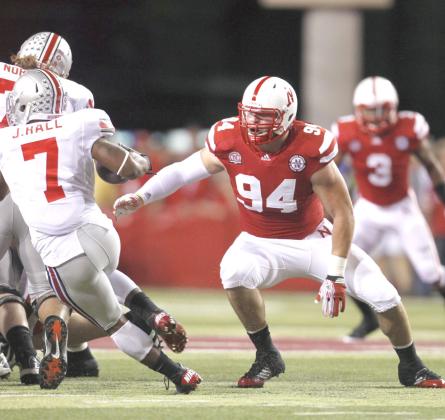
EDITOR’S NOTE: Huskers Illustrated is a full-color magazine containing all things…Huskers! It is published monthly by Syndicate Publishing. Each month we will include an article from that publication in the Courier.
Sometimes in his quiet moments, Jared Crick believes maybe Nebraska fans now see the Husker teams he played for in a more favorable light.
From 2008 to 2011, NU was 9-4, 10-4, 10-4 and 9-4, but Crick never won a conference championship nor did he play in a BCS bowl.
“I hope people look back and appreciate what we were able to do during those years,” Crick said. “People used to say the only thing we did was win a whale trophy at the Holiday Bowl.”
At the time, a “whale trophy” did not meet fan expectations for a team that came close to winning two Big 12 championships which would have put NU in BCS bowls.
It’s the unintended backlash of the standards set by Husker national title teams of the mid-1990s.
“People just look at 1999 to today and act like there wasn’t any Nebraska football these last 23 years,” Crick said. “Every year as a starter I won no less than nine games. It is really hard to win nine to 10 games a year so people might appreciate it more after what the football team is going through now.”
Not only was the team close to winning championships and being recognized as one of the best teams in the nation, Crick was also on the cusp of garnering All-American accolades, even while playing in the shadow of the dominant Ndamukong Suh.
“It was a double-edged sword playing alongside Suh,” Crick said. Yes, playing with Suh made his job easier, but some viewed Crick’s contributions as a product of Suh’s presence.
There was really no avoiding the conundrum. An example came in 2009 against Baylor. Crick set an NU record for sacks in a game with five, which still stands. Crick also tied the school record of seven tackles for loss while registering 13 total tackles, including 10 solos.
Numbers like that don’t happen for an average player, regardless of the circumstances. “Baylor had a game plan to double team Suh and then cut block the rest of us,” Crick said. “I used my hands and athleticism to make a lot of plays. I didn’t feel disrespected; they just didn’t know who I was. I was a first-year starter who really didn’t prove himself yet. But I feel people look at the success I had in that game because of Suh.”
As time went on, it was Suh who started to benefit from playing alongside Crick, making for a dynamic tandem. Crick would eventually draw double teams and that was when Suh’s stats jumped even more.
Call it a good problem to have.
“Suh was more thunder and I was lighting … we worked well together,” Crick said.
During that 2009 season, on one of the top defenses in the country, Crick recorded 73 tackles, with 15 tackles for loss and 9.5 sacks. His sack total ranked second on the team behind Suh and sixth in the Big 12, while his 15 tackles for loss were third on the team, along with 16 quarterback hurries.
In the conference statistics, Crick was second only to Suh in tackles per game among all Big 12 interior defensive linemen, averaging 5.2 per contest. Meanwhile Suh led the team with 85 tackles, tackles for loss (24), sacks (12) and quarterback hurries (26).
Even though Crick was an All-Big 12 first-teamer, critics were waiting to see how he would do without Suh. The pressure to live up to expectations and adjusting to new defensive line mates affected Crick early in 2010.
“I was getting double-teamed and Baker (Steinkuhler) was a first-year starter and figuring out his niche. So, my stats starting out my junior year were not very good,” Crick said. “I wasn’t getting any sacks or pressure on the quarterback. If you take away a guy like Suh, it doesn’t matter who you throw in there, it is going to be different.”
As Steinkuhler upped his play, Crick’s stats started to mirror those when he played with Suh. The defense was potent once again ranking among the top 12 nationally in scoring defense, total defense and pass defense. Crick led the team with 9.5 sacks and 17 tackles for loss. His sack total was second in the Big 12 and his 5.0 tackles per game were the most among Big 12 defensive linemen.
Stats don’t lie. Crick proved he could be just as productive without Suh. Crick credits coach Bo Pelini who took over for Bill Callahan.
“Callahan, he was a genius but couldn’t translate to a 17-year-old kid like myself,” Crick said. “He was speaking at a football doctorate level where I was just in Football 101 class.
“The defenses were completely different and I didn’t understand what anyone was saying. All I knew how to do was to chase the football and tackle the guy who had it. Under Callahan the offense was scoring like 35 points per game, but the defense was giving up 42, so the X’s and O’s were bad, the team was not together.
When Pelini took over, Crick said he got a fresh start, as did Suh. “He turned the culture around and got us to love playing football again and come together as a team,” Crick said. “We had tough workouts that guys have never been through before and we bonded.”
Under Pelini, Crick was asked during the spring of his redshirt freshman year to move from defensive end to tackle in order to utilize his speed. He also had to put on 35 pounds and had five months to do it.
When NU moved to the Big Ten in 2011, Crick and the rest of the Huskers discovered they weren’t designed to handle Big Ten teams on a weekly basis.
“We were not built for going against teams like Wisconsin. As much as we tried to get ready for the Big Ten, it wasn’t going to happen,” Crick said. “I was a defensive tackle at 270 pounds going against an offensive line of Wisconsin where everyone was 6-6 and 320 pounds at the lightest.”
It was a different world from the Big 12 “where everything was razzle dazzle and speed oriented,” Crick said.
No. 8 Nebraska got hammered by the No. 7 Badgers 48-17 in Madison in 2011. It was a rude awakening for a team billed as “The Big Ten’s New Bully” by Sports Illustrated in its preseason college football edition and thought it could waltz into the Big Ten and dominate from the start.
As for Crick, he began to question why he came back for his final year in Lincoln. “I could have left after my junior year and been a first-round draft pick but wanted to get my degree and play against the Big Ten teams,” he said. “But after the game against Wisconsin, I thought, ‘Why did I come back to get pummeled by these dudes?’” Making matters worse, Crick suffered a torn pectoral muscle the following week against Ohio State causing him to miss the rest of the season after only playing five games. Just like that, his college career came to an end. There would be no All-America or All-Conference honors, and his NFL Draft status was going to take a hit. Crick had been projected by ESPN’s Mel Kiper Jr. as No. 18 overall in his 2012 draft board.
“After I got hurt and teams saw how much I weighed (279 pounds) and ran (4.94, 40yard dash) at the NFL Combine, that knocked me down,” Crick said.
It was all tough to swallow for the preseason first-team All-American and the No. 1 defensive lineman going into his senior year.
Still, Crick was taken by the Houston Texans in the fourth-round (126th overall) of the 2012 NFL Draft. He emerged as a starter in 2014 and continued in 2015, starting 31 games.
“I was drafted to a veteran defensive line at Houston with J.J. Watt, so I was able to sit back and learn,” he said. “Then in my third year, I was able to start and did pretty well.”
After four years with the Texans, Crick signed a two-year deal with Denver. In 2016, he started 15 games and played the most snaps of any defensive lineman in the league. But in September the following year, he was placed on injured reserve after back surgery.
He’d injured his back in fall camp while hitting an offensive tackle. Pain shot down his back, and his legs went numb.
“I thought I was paralyzed,” he said. An MRI eventually showed that half a disc was torn off and had crashed into and lodged near his spinal cord.
Crick rehabbed in Denver and tried to make a comeback, but his football career was over.
“I tried out for the Jets and Bills in 2018 but making a team wasn’t going to happen so I retired,” he said. “I feel like if I wouldn’t have gotten injured, I would still be playing.”
Crick, now 34, and his wife, Emily, decided to move back to their hometown of Cozad, Nebraska, in 2019 and bide their time while searching for new opportunities. It turned out those opportunities were in Cozad, where family and a new job convinced them it was the place they were meant to live.
“I was looking for work and Farm Bureau Financial Services wanted to open an office in Cozad, so the job just fell into my lap,” he said. “I like helping people and educating them on their (insurance) coverages. In a lot of cases, they are relying on their agent to take care of them. Nobody has come in asking for autographs or (to) talk football, so I must be doing the insurance thing right.”
These days, it’s rare that he’s recognized as a former Husker and NFL vet. That’s fine, he says. He’s moved on in life and enjoys his job and family.
“My wife and I live pretty boring lives,” Crick said. “We are just living vicariously through our two sons.”