
Lower Loup NRD Public Hearing Draws Large Crowd
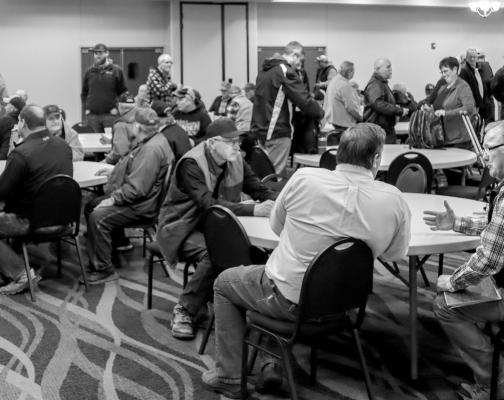
Proposed changes to Lower Loup NRD rules and regulations drew attendees from across the District to a series of recent public meetings, and a public hearing. At public meetings on Jan. 20 in Genoa, and in Ord and Broken Bow on Jan. 26, farmers, ranchers, commercial fertilizer dealers, agronomists, political figures, and others in attendance heard from Lower Loup NRD experts who presented scientific data showing the negative effects of applying commercial nitrogen fertilizer in the fall.
Application of anhydrous ammonia and other commercial fertilizer after harvest is a common agricultural practice in parts of the Lower Loup NRD. Charged with protecting water quality, the agency’s Board of Directors is considering a rule change to prohibit fall application of commercial nitrogen on irrigated acres district wide. The median nitrate level in Nebraska has doubled since 1978 and continues to climb, increasing health risks for residents exposed to nitrates in drinking water.
Fertilizer applied after harvest but before spring planting is exposed to unpredictable weather for six months or more without any crops to take it up. Rain events, or snowmelt fueled by warmer temperatures, can wash this fertilizer into streams and rivers, or deeper into the soil profile where it migrates out of the root zone and increasingly closer to subterranean water supplies. Surface water and groundwater are both important sources of drinking water for Nebraskans, including those with domestic wells, and residents who rely on municipal water systems.
Russell Callan, General Manager of the Lower Loup NRD, said that research shows that applying nitrogen during the growing season, or close to it, is best. “We don’t want to stifle growth. We want our producers to be successful,” Callan said. “Part of that success lies in the more efficient use of chemical fertilizers that can increase yield exponentially when used correctly and applied at the right time, or become money wasted when those chemicals wash away or leach into our ifinite water supply and threaten the health of our family, friends, and neighbors. It just makes good sense to put nitrogen fertilizer in the ground when the plants are there to use it.”
For more information, visit www.LLNRD. org or call (308) 728-3221. The Lower Loup NRD is located at 2620 Airport Drive, Ord, Nebraska, 68862.