

Discovering a New Chapter of Family History
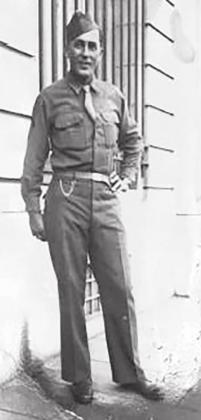
The family lore of Henry Miller tells of a hard-working farmer and rancher, a caring husband and a man who loved his family above all else. Most of his grandchildren rely on the stories told around the table at family gatherings, the memories of those who had met and loved Henry passed down like tokens to create a mental picture of the man himself. Over 40 years after his death he remains so present in the hearts of his family that they embarked on a journey to follow in his footsteps that were once nearly forgotten all the way from Callaway, Nebraska to Antwerp, Belgium.
Henry Miller did not talk much about his time in the service except to say that he was a cook. And a cook he was. However, the second job title listed on his military records offered more to the story. Listed under Military Occupational Specialty was AAA Gun Crewman with the 494th Antiaircraft Artillery. This opened a new avenue of research of an unspoken part of his past that remains alive today. Henry departed the United States training base on August 5, 1942, and would not see American soil again for over three years. His bases ranged from the volcanic outcroppings of Iceland to a base just outside of Glasgow, Scotland and a deployment his family had never heard about: Antwerp, Belgium.
Not much is written about the 494th, their role in the war almost forgotten all these decades later. However, the memory of their service is remembered in the small town of Putte, Belgium. The family found a blog site of a World War II Belgian historian, Jelle Thys.
One of the only ports still operational after years of Nazi occupation in Europe was that of Antwerp. Once the Allies had secured the port it needed protection around the clock from German planes and the new V-1 rockets. Nests of anti-aircraft machines and their gunners were set up surrounding this vital port city. Which is how the Miller family found themselves stepping into the very field where Henry’s Unit, Battery C, was stationed.
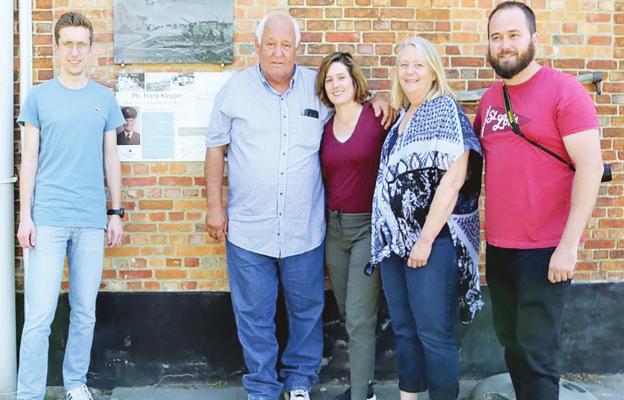
The Miller family, Glen, Teri, their daughter Mandi, her husband Austin Elkins and family friend Jeanelle Grabowski boarded a train from Paris to Antwerp last week and were met at the station by the Thys family. The Americans were treated to a private tour of a fully restored Nazi bunker, memorial to the 494th, lunch at the Thys family home, as well as a visit to the exact locations where Henry’s unit was set up.
Glen’s eyes would occasionally mist over as he looked at some of the places where his father would have spent long nights gazing up at the sky for incoming rockets, he and his unit dedicated to the protection of this little corner of the world, no doubt missing home and writing letters to the Scottish lass he had met while stationed in Glasgow. He would one day marry her and they would move back to Nebraska. Henry and Dorothy Miller would start a farm outside of Callaway, leaving most of the dark memories of the Second World War thousands of miles away. Raising their four children in the solid conviction of right and wrong, of strong friendships, selfless bravery and most of all, love. The full story of their sacrifice and hardship remaining obscured from those they did not wish to burden with it. They are remembered as examples of the Greatest Generation.
Several letters from the American soldiers stationed in Putte tell of the town residents doing the laundry of the soldiers, of welcoming them into their homes and showing them the sort of hospitality that must have reminded Henry of his small town, back home in the Seven Valleys. The Belgians welcomed the Miller’s as warmly as they had the 494th, the bonds of friendship continue to span the Atlantic and serve as a testament to the grit, gumption and gratitude that still remain all these decades later.
“Emotional ride”: War Experts Guide Family of American Veteran
*The local newspaper in Putte, Belgium ran an article on Sunday, May 15, chronicling the story of the Miller family’s trip. Below are some excerpts from that article.
Father and son Eric and Jelle Thys and Robin Vertenten are all members of the Putse circle of friends of WWII collectors Kamp 44. It was more by chance that Jelle came into contact with the family of Henry J. Miller. The American married a Scottish woman in 1945 whom he met when he was stationed in Glasgow in 1943.
“Last year Henry's immediate family decided to visit Europe,” says Jelle. “His son Glen had never been there himself. Granddaughter Amanda suggested to her father to change that and immediately take a look at the places her grandfather had been during the war.”
Henry Miller passed away in the 1970s. His son was barely 16-years-old at the time. “The family only knew that he was stationed with the 494th Anti-Aircraft Battalion. They eventually found me via Google,” says Jelle. “We got to talking, after which I advised them to definitely visit Putte. After all, this is where their father and grandfather really have been. So they could see the fields here where he was active with his battery.”
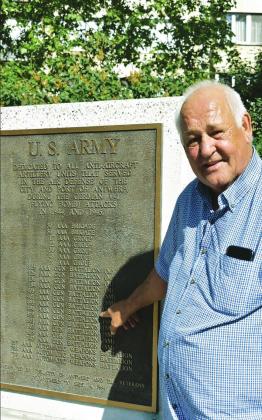
The presence of American anti-aircraft guns in Putte had everything to do with the V-bomb offensive with which Germany wanted to hit the port of Antwerp from the end of October 1944. The aim of the American gunners was to protect that crucial logistical artery as best they could by shooting the V-bombs from the sky.
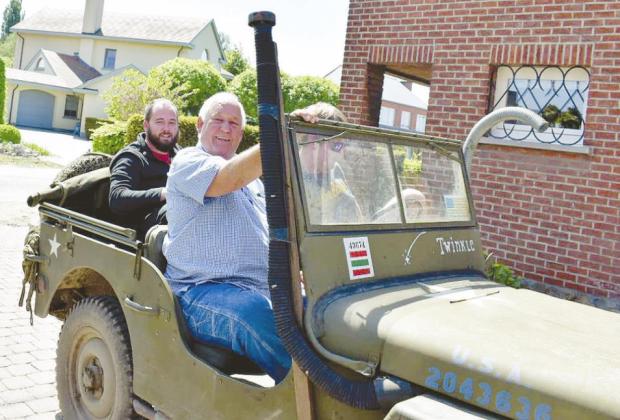
The company of son Glen, his daughter Amanda, their partners Teri and Austin and family friend Janelle arrived in Antwerp by train from Paris on Saturday. “We picked them up there and showed them, among other things, the site of Cinema Rex, where more than 500 people died from a V2. In Putte, Robin made his Jeep available to visit some relevant places and the monument of Frank Klepper," says Jelle. “We also went to Le Grand Veneur in Keerbergen, the headquarters of operation Antwerp X.”
According to Jelle, it was an emotional one, especially for Henry's son. “His father died when he was young and he never talked much about the war,” he says. “He always said he was a cook, but once his battalion was put into combat, he was also a gunner. He probably saw things that he didn't like to talk about later."