

Healing Division, Restoring Unity
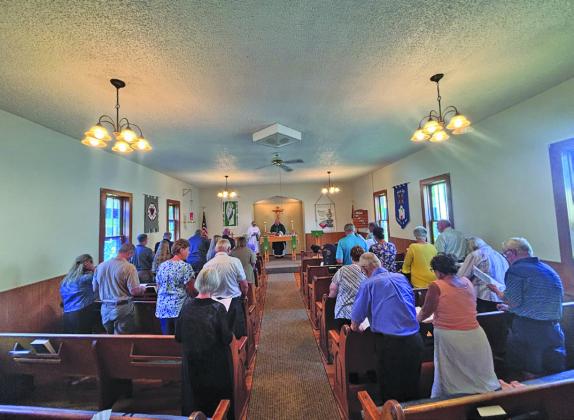
Members of the Callaway Lutheran Church gathered for a special service commemorating 50 years in the community on Sunday, July 12. Bishop Scott Johnson was an honored guest at the celebration and led the service. (Photo by Josie Reiff) Gathering for a photo during the celebration of the 50th anniversary of the Callaway Lutheran Church were front row, from left: Josie Reiff, Lauren Reiff, Leta Roth, Marianne Boldt, Lynnlee Rice (child), Betsy Spanel, Mary Jane Reinhard, Erin Reiff, Neltje Reiff, Ron Roth, Tami Kline, Jennifer Troxel, and Linda Mowrey; Back row: Ryan Boldt, Doug Boldt, Kindle Rice, Mike Reiff (partially hidden), Marty Kline, Leroy Rice, Kay Fahnholz, Darrel Fahnholz, Larry Mowrey, and Todd Boldt; Standing on step: Dennis Land, Bishop Scott Johnson, Joyce Kolbo, PMA of Callaway Lutheran Church, and Connie Anderson. (Photo courtesy Janel Brestel)
PART 1 OF A 2-PART SERIES ELLEN MORTENSEN
*EDITOR’S NOTE: In September 2025, I had the privilege of sitting down with Cecil Woodward, one of the founding members of Callaway Lutheran Church. He wanted to share the history of the church while he was still able. Sadly, we lost Cecil less than three weeks later. Whether it is family legacy or community history, may we all be as diligent as Cecil to make sure our stories are preserved for future generations.
Church was an important part of Cecil Woodward’s life as far back as he could remember. A small Evangelical United Brethren (EUB) church was located in what once was the small village of Milldale, located between Callaway and Arnold on the corner of the Woodward place. Cecil recalled visiting his Grandma Rarden on weekends and attending the EUB church.
“Then we would go to the gravel pits after to fish. We would catch little sunfish and take them home to fry up for dinner,” he recounted with fond nostalgia.
One of the members of the little EUB church was Rhoda Chesley Chaloupka. She and Dr. M.L. Chaloupka were married in the church where Rhoda had attended all her life, in 1948. However, as membership began to decline, the leadership made the decision to merge with the Methodist Church. Fueled by the desire to save the small country church, Rhoda and Doc took possession of the church and had it moved to the east side of the city park in Callaway. A cement foundation was poured to set the church on, and all seemed well. That is, until it was discovered that the land where the church had been placed was actually owned by the Griffiths family and not the Village. Without anyone overseeing the caretaking of the building, it was left to get run down; windows were broken out, and the pigeons took over, as Cecil recalled.
When Cecil and his wife Hazel moved to Callaway in 1970, the Lutheran Church no longer existed in the community. “We tried other churches, even drove back and forth to Cozad to St. John’s Lutheran, but that became more difficult in the winter. Nothing clicked,” Cecil recounted.
As the new owner/operator of the Sinclair gas station in town, Cecil said he began asking people who came into the station what had happened to the Callaway Lutheran Church.
“People were reluctant to talk about what happened, but one at a time they slowly began telling the story,” Cecil shared.
Members of the original church that he recalled included Ray Gladium, Leo Wendorff, and Paul G’Schwind. The original church was built when Cecil was just a boy. A branch of the Lutheran Missouri Synod, Cecil learned that the church was governed by three men, and when they made the decision to dissolve the church, that was that.
“The members were not included in the decision,” Cecil explained. “A truck was brought in, and all the items and furniture inside the church were removed. The building was moved to Thedford, the lot was sold, and a home was moved in its place.”
That was when Cecil and Hazel made the decision to do something. One Sunday afternoon, they invited about 20 people to their home to discuss either starting or reopening a Lutheran church in Callaway.
“We got ahold of Pastor Gorden Miller with the Broken Bow Our Saviour Lutheran Church and American Lutheran, and he helped with all the paperwork to get the church established,” said Cecil. “Now we had a congregation and established a church on paper, just no building.”
In the meantime, Shirley Nelson offered the use of her cafe in Callaway as a meeting spot for the newly established congregation. “After the breakfast rush she would open the French doors to the dining room on the east side of the cafe. We would drink coffee and eat donuts, and she never charged us for the use of the room,” Cecil recalled. “Some would stay after to buy dinner for their families.”
As it turned out, the Lutheran Church was not the only one in town that was struggling to survive. Attendance had declined at the Episcopal Church, so the leadership offered to share their building with the newly formed Lutheran Church and split the costs. It was an arrangement that continued for several years.
As the old EUB church continued to deteriorate in the park, the Callaway Village Board reached out to Cecil and some other members of the Lutheran Church about taking over the building and moving it to a new location. Though Cecil was not in favor of the idea, the other members were and voted to take on the church and establish a new Callaway Lutheran Church building.
“I felt all was going well sharing the cost and building with the Episcopal Church. And leaving might mean they would lose their church,” Cecil explained. “But the majority rules.”
The Village sold the building to the congregation for $1 and the papers were drawn up to transfer ownership to the Callaway Lutheran congregation. However, the Village had two stipulations: the church must be moved to a new location, and the inside of the structure could not be changed. The congregation agreed with the addition of a stipulation of their own: that if, for any reason, the congregation ceased to use the church, it would be given back to the Village and displayed as a showplace as intended by Doc and Rhoda.
The agreement was printed in the newspaper as such. However, it did not get included in the Village Board minutes. That was an oversight that would prove to have a big impact on the future of the building.
We will conclude this story on the history of Callaway Lutheran Church in next week’s issue of the Courier.