
Death of the Dial Tone: Nebraska’s Dwindling Pay Phones
If you were born before 1990, chances are you have used a pay phone at some point in your life or at least familiar with them. Perhaps, like me, you have memories of shoving quarters into the slot before your time ran out so you could keep talking to your friend. Kids today will never know that feeling.
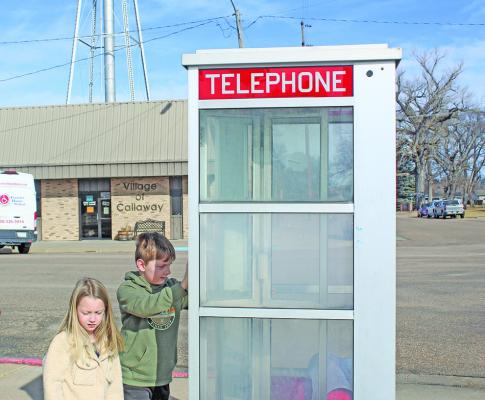
Nowadays, pay phones have become a novelty - so rare that when you do see one, it typically catches your attention and brings on waves of nostalgia. In fact, a remnant of that history still remains in downtown Callaway.
The phone booth sits on the corner of Kimball Street next to the fire hall, as it has for decades. The pay phone saw lots of use in its heyday, until it was taken out of commission a few years ago. And though there is no longer a phone left in the old booth, people occasionally still stop and visit. You may be surprised to learn, however, that there are still places in our state where a call can be made on such an “antique” device.
Lane Handke called his wife, Cathleen, the other day to tell her he was bringing home the shelves they needed to finish their cabinet. The call cost him 25 cents.
Then, the Pierce physician phoned a friend in Omaha just to say hello. This call cost him an additional eight quarters.
Handke made his calls from a pay telephone standing outside of the Pierce Telephone Co. building. He felt drawn to this pay phone by curiosity. Pulled toward it by nostalgia.
“I hadn’t used a pay phone in decades,” he said. “People were looking and wondering what I was doing. I thought it was kind of cool.”
The pay phone in the northeast Nebraska town is one of 81 still operating in the state, according to the most up-to-date numbers from the Nebraska Public
Cont. PAGE 5: Pay Phones Service Commission.
The few that remain tend to owe their continued existence to a six-decades-old state law meant to ensure access to once-essential technology. Today, they’re more a curiosity than a line of communication.
“They are a rare find these days,” said Cullen Robbins, director of telecommunications for the Public Service Commission. “Everyone has a cellphone.”
Robbins said working pay phones typically remain in places such as airports — Omaha’s Eppley Airfield has one in each terminal — or hospital emergency rooms like Nebraska Medicine’s ER, which has one tucked in a corner.
“You don’t seem to find them at gas stations like you used to,” Robbins said. Actually, you can … if you know where to look. One is available at the Eagle Travel Center, where U.S. Highways 34 and 283 meet in Arapahoe. Another working pay phone is inside Scott’s Place, a convenience store that sits where U.S. Highways 20 and 183 intersect in Bassett.
A regulation in place since 1968 requires certificated telephone service providers in Nebraska to maintain a pay phone for public use in each municipality it serves. Service providers can ask the commission for a waiver to take a pay phone out of service because of vandalism, lack of use, or excessive cost to maintain the phone.
Robbins said the commission typically receives — and grants — several requests for waivers each year, the most recent coming from the Hemingford Telephone Co.
The rapid demise of pay phones in some ways mirrors their rapid rise. More than 2 million pay phones existed in the United States in 1969, a century after the first one was installed outside of a bank in Connecticut.
Now, according to the Federal Communications Commission, fewer than 100,000 remain. The Nebraska Public Service Commission relies on reports from its carriers to track pay phones in Nebraska: 1,150 remained in the state in 2016, 417 in 2020, and 81 in 2024.
Telephone service first began in Callaway in 1901, when H.H. Andrews, John Moran, W.E. Shupp, A.L. Mathews, and J.D. Wieland got together and organized the Callaway Telephone Company. The first telephone office was established in Callaway about 1903.
The first building burned in 1907, and a temporary building was constructed and used for approximately a year. In 1908, the telephone office was moved to the building across from the present post office building and was used until the new building was completed in 1965.
The first switchboard used was a magnetic one. A common battery switchboard was installed in 1953 and used until the dial system replaced it, thus eliminating the work of the operators. The Callaway territory was switched over from the switchboard- type to dial on Jan. 27, 1965, and served with most of the lines underground. In July 1966, it was possible to direct dial long distance.
Dean Shadel was the first manager of the new dial system division of Callaway until his retirement from Great Plains Communications Inc. Based in Blair, Great Plains Communications celebrated its 100th year of business in 2010.
Cellular phone technology began to make its way into the Callaway region in the early 1990s. Cell towers erected in the area over the past couple of decades now provide reliable phone service at the touch of a button from just about anywhere.
One day, even cell phones will be considered a relic. And our children will wax nostalgic on them with their grandkids, just as we do today with the few pay phones that remain.