

Pronghorn Sightings Are Not Unusual Here

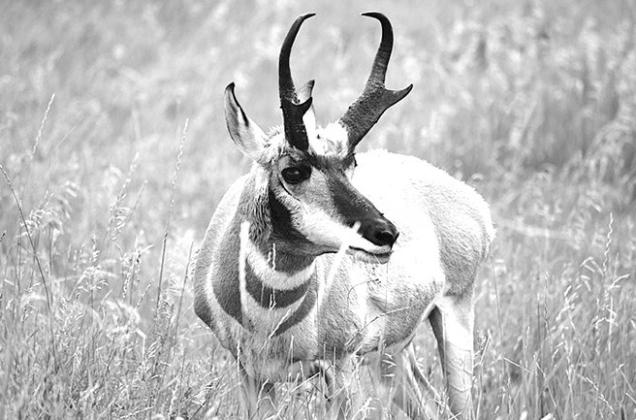
Years ago, a friend of mine and I set out to walk across the Sandhills from Highway 30 west of Gothenburg to Highway 2 at Halsey National Forest. We took off just after sunup and shortly thereafter came over a hill and there was a male antelope, more appropriately called a pronghorn.
Pronghorns in this area are not unusual. There was once a small herd that could often be seen north of Brady.
Pronghorns are not “true” antelopes. Those are found in the “old” world. Pronghorns are in a group by themselves, somewhat related to antelopes, but then again, they are also somewhat related to goats. They don’t weigh much and have very long legs. Because of that, they are easily the fastest mammals in North America, able to reach speeds of up to 60 mph!
It is estimated that in 1803, at the time of the Louisiana Purchase, there may have been over 40 million pronghorns roaming the Great Plains from Canada to Mexico, from the Missouri to the mountains. The only animal more numerous may have been the buffalo. However, like the buffalo, the pronghorns were almost hunted to extinction.
An article in the Aug. 17, 1895, edition of the Gothenburg Independent gave tips on how to hunt “antelope”. It noted that until recently, the “antelope” was so curious they could be approached well within gunshot or brought to the hunter by waving a white flag. The article went on to say that “now”, the only way to get into gun range is to stalk the animals in deep canyons that allow you to sneak up on them.
The difficulties in hunting pronghorns are threefold. First, they have amazing eyesight, and it is almost impossible to sneak up on them out in the open. Secondly, they communicate well with each other, and if one sees a potential problem, they will flare the white hairs on their rump telling all the other pronghorns that danger is near, and then third…those long legs quickly take them out of range!
Overhunting of pronghorns in Nebraska was recognized as early as 1907, and hunting them was restricted until the late 1950s. In spite of that, the population of pronghorns continued to decline, and in 1925, according to one source, there were only 147 pronghorns left in Nebraska.
Pronghorns breed in the fall, and the females give birth to one or two fawns in the spring. Within a day, the young are up and walking, and they stay with their mother for almost a year. Typically, pronghorns live about 10 years.
The hunting season for pronghorns is from September through December, depending upon the weapon you use. The east boundary for legal hunting is Highway 47, and Highway 30 is the boundary on the south. But getting a permit is almost as hard as getting a pronghorn. For the Dismal Unit 346 area, applications were submitted last year, but only 30 permits were awarded.