

Kolbo Credits College For Saving His Life
*Editor’s Note: As the Courier pays tribute to our veterans, we decided that it should warrant more than just one day or one week. We continue our series of veteran profiles this week with reflections from lifelong Callaway native Raymond Kolbo.
As a teenager, Raymond Kolbo had dreams of becoming a doctor. He now credits the pursuit of that dream for preventing him from being shipped to Korea. In fact, Kolbo takes it one step further, saying, “It saved my life.”
Other than the years he spent at college and in the Army, Kolbo has spent his entire 96 years on Callaway area farms. He graduated from Callaway High School in 1947, then went on to Kearney State College, where he graduated in 1951.
“I was a biology major and was going to go into medicine, but if you didn’t have a family member that was a doctor or something, you had no chance of getting into medical school,” Kolbo shared. “They only took about 20, and most of them were all sons and daughters of doctors.”
After college, he went to work for a seed company in Fremont.
He and his wife, Shirley Roth, were married on May 27, 1951. They were high school sweethearts, “Ever since sophomore year”, he said.
Meanwhile, war had broken out in Korea, and Kolbo was drafted.
He vividly recalls the day he left.
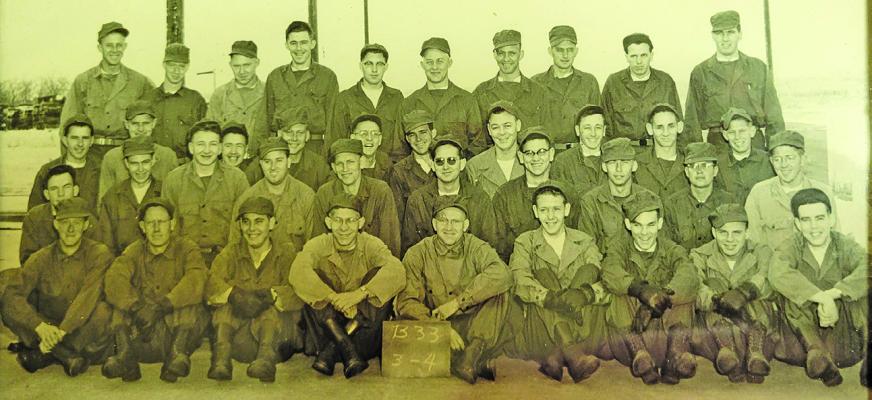
“It was Jan. 2, 1952, and 12 below zero in Broken Bow. We went to Joplin, Missouri to Camp Crowder.
They warned us in Kansas City that there was an ice storm in Arkansas.
And you couldn’t believe how thick the ice was! I’ve never seen ice that thick,” he recalled. That was when he discovered how beneficial his biology studies in college would be. “I went to college during the summers too, so I could get done sooner because I knew I would have to go to the Army,” Kolbo explained. “After basic training, everybody went to Korea except for three of us.”
The year 1951 was a milestone for Kolbo; he was married, graduated from college, and drafted all in the same year. “I was supposed to go in September that year, but they had enough from this area to fill the quota so I didn’t have to go until January,” he explained.
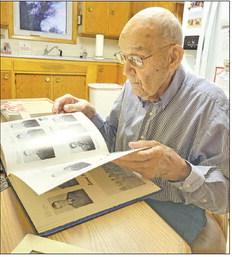
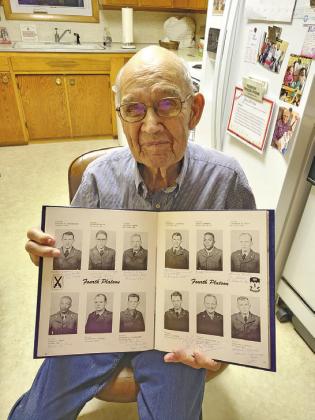
While so many of his peers were heading overseas, Kolbo was assigned to work in the lab at the hospital in Fort Riley, Kansas, where he had completed basic training. “I worked in microbiology, looking through a microscope all day,” Kolbo said.
After two years, he came home and was on reserve for the next six years. He and Shirley have three children: Sandra, Jackie, and Jim. He lost his beloved Shirley in October 2012.
In reflecting back on his years of college and military, Kolbo is thankful. “It saved my life!” he stated emphatically, referring to his decision to pursue college. “I was one of only three who didn’t get shipped to Korea. My bunkmate was killed as soon as he got over there.”
He explained that his lab work at Fort Riley mainly consisted of identifying different bacteria and infections. “I still know all of the normals of the blood work and bacteria,” he said.
While he admits he did like farming, he also feels like he missed out on fulfilling his true dream. “My wife just couldn’t stand living in the city with the houses close together and stuff. We lived in Manhattan, Kansas, and she did not like it.”
He now lives on the family farm where he grew up with his two brothers - he was the middle one. Both of his brothers also served in the Army; the younger one went to Germany, and the older one to Korea and Japan. Kolbo served in the 5021 Medical Detachment and spent all his time at Fort Riley.
“I would get orders to go someplace, but the doctors would pull me off. They wanted to keep me there,” he said with a chuckle. “I can still identify some cancer cells, but there wasn’t too much about that then.”
According to Wikkipedia, after the end of World War II in 1945, Korea, which had been a Japanese colony for 35 years, was divided by the Soviet Union and the United States into two occupation zones at the 38th parallel, with plans for a future independent state. Due to political disagreements, the zones formed their own governments in 1948.
On June 25, 1950, the Korean People's Army (KPA), equipped and trained by the Soviets, launched an invasion of the south. In the absence of the Soviet Union's representative, the UN Security Council denounced the attack and recommended member states to repel the invasion. UN forces comprised 21 countries, with the United States providing around 90% of the military personnel.
Combat ended on July 27, 1953, with the signing of the Korean Armistice Agreement. The conflict caused more than one million military deaths and an estimated two to three million civilian deaths. North Korea became one of the most heavily bombed countries in history, and virtually all of Korea's major cities were destroyed. No peace treaty has been signed, making the war a frozen conflict.
Raymond Kolbo counts himself extremely fortunate not to be among the statistics of that atrocity.
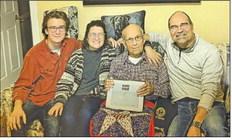
Raymond Kolbo was presented with a Quilt of Valor with his son Jim, right, and grandchildren present. (Photo courtesy Raymond Kolbo)