

Duty Called, Schaad Answered
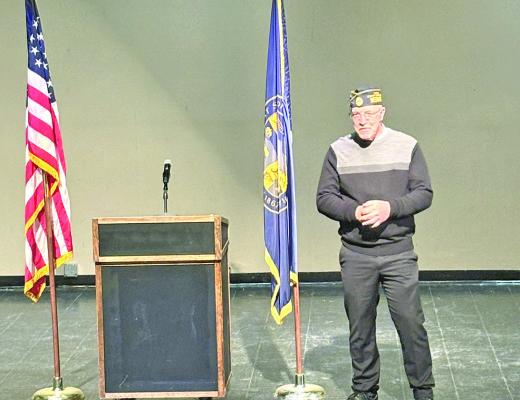
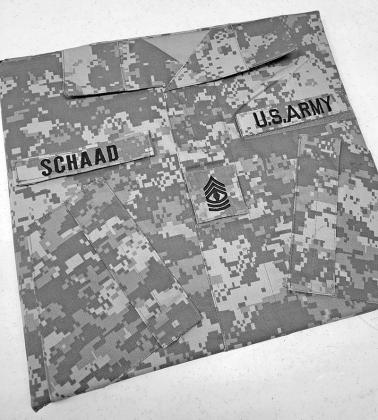
*Editor’s Note: As the Courier pays tribute to our veterans, we decided that it should warrant more than just one day or one week. We continue our series of veteran profiles this week with the second half of the military story of Legion Commander William “Bill” Schaad.
“I boarded a bus going to the Manhattan airport, then to the Kansas City airport, then to Baltimore, and to Kuwait with several replacements that I was put in charge of until we got with the unit in Iraq. At Kuwait, we flew fixed wing into Iraq and then sat on the tarmac all day until early morning when we loaded on a Chinook.”
Bill Schaad vividly recalls the day he headed overseas for another deployment with the U.S. Army. This time it was to fill a vacancy left by a friend who did not make it home from Iraq. It was now a few years post 9/11, and the Middle East was a very unsettled place.
“Talk about being concerned! We were flying in as replacements and had no ammo until we got there,” Schaad shared. “The chinook started to have problems and had to set down in a compound in the dark and they were pounding on the aircraft as they were having problems with the hydraulics. I was thinking if the tail gunner gets taken out, I had better get on that gun fast.”
The soldiers arrived in Taji, Iraq during the early morning hours. Schaad recalls that he was greeted and taken to his quarters, and told he could sleep for
Cont. PAGE 5: Duty Called a few hours before he reported. While sleep sounded tempting, Schaad was insistent that he would not rest until he was given ammunition. “I did not want the solders in the company that had just gotten used to a new First Sergeant have to go through it again,” he explained.
One of his first tasks after taking over Batallion Operations was to set up a memorial service for several fallen soldiers. “It is different in a combat zone; the soldiers pull up in their gun trucks and get out and attend memorial service. Then get back in their gun trucks and go back outside the wire, usually to the exact locations that the fallen soldiers had been attacked.”
After returning from Iraq, Schaad said the plan by the Department of the Army was to have the 70th Engineering Unit deactivated. Most of the soldiers had already departed for other stations, when the Army decided to keep the unit activated and deploy to Afghanistan. So, they went to work rebuilding the battalion.
While in Iraq, Schaad had been promoted to First Sergeant. After going through another training he once again found himself at the deployment building. “I went into Afghanistan with 102 soldiers, one of which was a woman assigned to us as a communications specialist. Our main mission as combat engineers was route clearance,” said Schaad. “We were also general support to the 82nd Airborne.”
While on an earlier deployment in Korea, Schaad’s son had also enlisted in the Army. Now, while serving a 15-month deployment in Afghanistan, his son was also deployed to the region - in Iraq.
“The first night we were at Salerno we had rocket attacks; the big voice would say, this is not a drill go to the nearest bunker and wait further instructions. We would get an all clear, then another attack, then all clear,” Schaad recalled. “That went on about all night until authorization was given to send out outgoing rounds. I would have to go to the medivac line to be there to secure weapons and equipment from injured soldiers from the batallion.”
Schaad recounted flying around Afghanistan to provide command presence. “One one of these flights we took fire from below,” he said. “On night flights everything is blacked out. We flew into Sharana for a hot unload. I was the first out and the crew chief pointed to dim red lights in the flight tent. As I started that way she slammed me back against the Blackhawk. Another Blackhawk was coming in blacked out.”
Schaad and his son were fortunate enough to get R&R at the same time, and both were able to be home when his grandson was born. Because he wanted to time his R&R to coincide with the birth of his grandchild, Schaad took it toward the beginning of his deployment. “It was great, but that meant we still would have close to 12 months in the combat zone,” he explained.
Schaad was selected by the battalion to build a bridge at Jaji near the Pakistan border. “We established the security plan and the 2nd Platoon had trained the Afghan soldiers for two months to assist with this mission,” said Schaad. “The construction engineers in the area decided to start the abutments before the security fence was in place. A terrorist walked down to the site with some children and blew himself up and killed three U.S. soldiers. At the firebase we stayed in tents and were rocketed one of the first nights. We did not have a bunker. We completed the bridge without the amount of crew we should have had. It was completed under sniper fire and RPG fires.”
Schaad said that at the 10-month mark of his deployment he began writing endof- tour awards for his soldiers. “Each of the three line platoons had over 100 IEDs located or hit during route clearance missions at that point. At least 90% of the soldiers in company received combat action badges.
“So, we completed our 15 months in Afghanistan and returned to Fort Riley,” he continued. “Of the 102 soldiers that went into Afghanistan with C Co 70th EN BN all came back alive. Two lost legs and there were several others with visible injuries, and others with not so visible injuries.”
The 70th Engineer Batallion received Meritorius Unit Citations for their service in Iraq and Afghanistan.