

Saluting Our Area Veterans
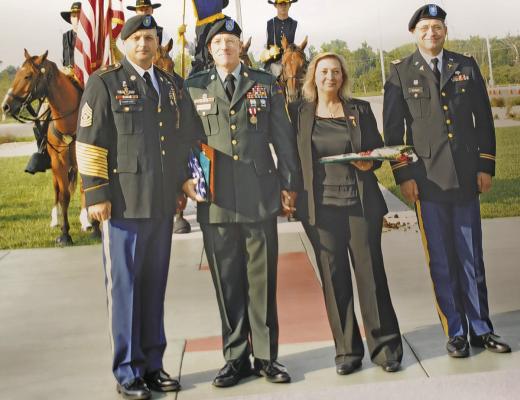
* Editor’s Note: As the Courier pays tribute to our veterans, we decided that it should warrant more than just one day or one week. Therefore, this feature is kicking off a series of veteran profiles as we recognize with gratitude and appreciation those who have served our great country.
Oftentimes, a person’s decision to join the U.S. military is precipitated by family members who have also served. Following in the generational footsteps, so to speak. The Schaad family of Callaway is one such example.
Bill Schaad was born and raised in Callaway, graduating with the class of 1974. Though he admits he considered going into the military directly from high school, Schaad decided to go to college instead and pursue his passion for construction.
After a little more than a semester at Mid-Plains Community College where he was majoring in building construction technology, Schaad left school and enlisted in the U.S. Army in late 1975.
His journey began at Fort Knox, Kentucky, for basic training and armor crewman training. “Being a simple guy from rural Nebraska, the environment upon arrival was a completely new world,” Schaad recalled. “We were moved into a room with what looked like a big feed bunk in the center and told to strip down and put everything in it. They told us, now is the time to get rid of your drugs and weapons without questions. I was shocked at all the drugs and weapons that came out.”
After graduating from basic and AIT, Schaad was off to Germany, arriving first in Frankfurt. “What a strange feeling, as it was foggy and the train tracks close by looked like something out of a WWII movie,” Schaad said.
He was transported to Wurzburg to the 3ID and then assigned to A Company 1/64th Armor at Kitzingen. “When I arrived that afternoon, they said we were moving out to the field early the next morning. I was issued some cold-weather field gear. The next morning, we loaded all weapons and gear on our tanks and moved to our border position areas to do some training for two weeks,” he shared.
It was the Cold War era. Schaad said they knew they were facing about 4-to-1 odds from the Soviet Union across the eastern border. “The idea was to engage, then fall back, engage again, then repeat until we were back along the river and then dig in and hope to maintain until stateside troops arrived to reinforce,” said Schaad. “The three years I was there, we had many alerts that required us to be out the back gate in one hour with all gear. The tanks were always loaded with the main gun rounds.”
Schaad said he was typically in the field training for well over 200 days of the year. After three years in Germany, his orders took him to Fort Hood, Texas, where he served as a tank commander with 1/67 Armor.
“We were a designated rapid deployment unit. One early morning, we got a call saying this is the real thing – report immediately. This was 1979 when the hostages were taken in Iran,” Schaad recounted. “We worked all day packing and loading tanks at the railhead to be able to move south to a port. The Battalion Commander arrived and spoke to us, and said, ’We do not have the privilege to go kick the Iranians' ass.’ Then we had to unload everything and move it back to the Motor Pool.”
Schaad was at Fort Hood for nine months when his enlistment was up. He returned home to Callaway and went back to MPCC, and finished his associate degree in building construction technology. He started his own business, WR Schaad Construction, and for the next 10 years, he ran his company and enjoyed life as husband and father. However, the Army was not out of his blood just yet, and when the Gulf War began, he enlisted again in 1990.
He reported to Fort Leonard Wood, Missouri for combat engineer training. However, even though he had graduated from the NCO Academy before getting out, Schaad was told that since he had been out for more than five years, he would have to go through basic training again. He reentered as PFC and was promoted to SPC at basic training graduation. After completing combat engineering AIT training his orders came in. He was going back to Germany.
“The big difference was I was married now with a wife and children to go with me,” he said.
Schaad was assigned to the 293rd Engineers which was transitioning to the 40th Engineers. He was one of only about five soldiers who started with the 40th. He was part of a 14-man team that trained with over 700 miles of marching before heading to Nijmegen, Holland, to represent the U.S. in the International four-day 100-mile march.
“This is in the area during Operation Market Garden in WWII that is portrayed in the movie ‘The Bridge Too Far’. We completed the march, and at the end, we changed into clean uniforms and did the final 6-mile march through Nijmegen with over a million people watching, mostly waving US flags,” Schaad recalled. “This place was under occupation for so long during WWII that they still remember the US liberating them. It was probably one of the most memorable events of my life.”
He underwent a great deal of engineer training in Germany that included demolition and bridge training in preparation to go to Bosnia. However, the Department of the Army had another plan.
“Since Fort Riley was short of Engineer NCOs, my extension was disapproved, and I had to PCS (permanent change of station). Both times in Germany, I toured Dachau Concentration Camp. So, after another three and a half years, I departed Germany in 1995.”
He was assigned to the 70th Engineer Battalion, where he conducted a lot of training in the field and at the National Training Center in California. He was promoted to Sergeant First Class and completed the advanced NCO engineer course at Fort Leonard Wood.
While stationed at Fort Riley, his engineer company was sent on a mission to Nogales, Arizona, to erect one mile of the U.S./Mexico border wall. “That was an interesting mission,” he shared. “As the foreman, I got to experience a little bit of what the border patrol goes through while we built the mile of wall.”
Schaad then received orders to report to Fort Stewart, Georgia in 2000, with a remote assignment at Statesboro, Georgia, to serve as an engineer trainer for the National Guard. He also had duties as an engineer liaison to FEMA along the East Coast. Then 9/11 happened.
“I hurried back to the Armory, and they had orders to secure the area since it was sitting along a busy highway,” Schaad recalled. “So, I helped them design and install a security fence with an entry control point. I got Levy orders in 2003 to go to Korea with a return assignment at Fort Riley. When I went to my Levy Brief, I expected my orders would be removed since Fort Stewart/3ID was being stop-lossed to go to IRAQ.
I was one of three who had orders remain for that month to go to Korea.
“I got my family moved back to Fort Riley and departed for Korea for one year unaccompanied. This would be the worst assignment for me in the Army,” said Schaad. “I was stationed at Camp Howze about 7 km from the DMZ. We received hazardous duty pay. My quarters were right across the street from the ammo dump, so I knew if something broke out from North Korea, we were an artillery target. That was not a pleasant feeling.”
After completing his year in Korea, Schaad returned to Fort Riley. But while he had been overseas, his son had enlisted in the Army, and his first grandchild was born.
“I attended several memorial services for deceased engineer soldiers who were lost in Iraq. One of those was the NCO I sat beside as honor grads,” said Schaad. “Shortly after, I received an email from the 70th ENG CSM in Iraq asking if I would fill his vacancy. I agreed and started my deployment training to be able to deploy to Iraq.”
“Talk about a place that gives you a bad feeling in your stomach; that is the Deployment/Movement Building at Fort Riley for me,” Schaad continued. “You say goodbye to family, and that is the point you know you are heading to a combat zone without knowing what the future holds.”
It is a feeling Schaad would experience several more times at that building.
We will pick up next week with Schaad’s journey to the Middle East, and crossing paths with his son in the same dangerous part of the world.