

The Early Bird Gets The Fish

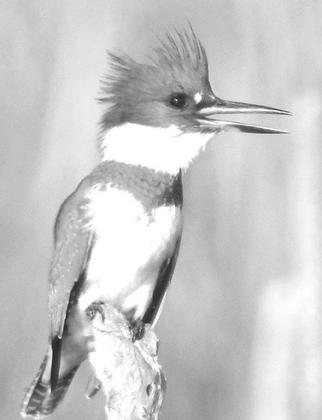
This past week I worked at the J2 Eagle Viewing Facility south of Lexington. The plant was offline all night and when I arrived Sunday morning the canal below the plant was partially frozen over.
When the plant came online the water rushing through the plant broke up the ice below the plant, which is what the eagles were waiting for in order to feed on the fish that came bubbling out along with the water.
I got tickled with one bird. Not an eagle but a kingfisher. A belted kingfisher to be exact. A male belted kingfisher. While there are 118 different kinds of kingfishers worldwide most are tropical species and only three reside in the U.S. Two of those three are only found in southern Texas. The belted kingfisher is the one species found all across the U.S and in Nebraska.
Kingfishers feed on fish, insects, frogs, etc. found in or near water. The bird will sit on a tree limb overlooking the water and when it sees likely prey it will dive down and grab the small fish, frog, or crayfish.
Belted kingfishers are robin-sized birds that are gray-blue on their head and back, and white on the breast. There is a broad blue breast-band across the white breast. The head is large and crested.
This is one of a few species of birds in which the female is more colorful than the male. The male has a single breast-band, which is blue and the female not only has the blue breast-band, but below the blue breast-band is an orange breast-band.
Biologists are not sure the reason for the difference in appearance but they believe it may be a way for the male to recognize a female in his territory and thus go “woo” her. The females migrate but many times the male does not. However, the next spring, if they have been successful at producing young, she will return to him.
Once successful at “wooing” her, both birds will dig a tunnel into the bank of the canal or riverbank, sometimes as long as six feet! The opening of the tunnel is near the water but then the tunnel itself angles upward. This may protect the eggs if the water level rises.
The female will lay half a dozen eggs, which both birds brood for about 24 days. Both the male and female feed the young birds for another 30 days. Then she may produce a second brood.
At the end of the summer the female says goodbye and heads south, possibly as far as South America. The male may stick around all winter. Because of them being territorial and antisocial with others of their own species you rarely see more than one or two together. Generally, the “peak count” reported in Nebraska from any single location is usually only five or six!
Below the plant this winter the peak count has been one and he was a busy little bird catching and eating two or three small fish before the larger eagles even got started.