

Appreciating The Complexity Of Lightning

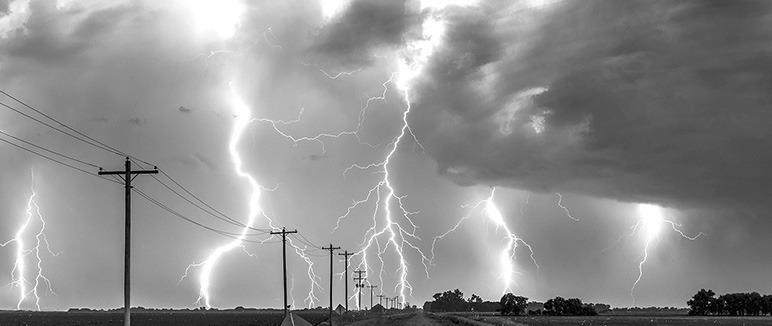
Don’t you love the sound of that first thunderstorm after winter with all the lighting and thunder?
Lighting is described as a ”natural electrical discharge of very short duration and high voltage between a cloud and the ground or within a cloud”. This high voltage discharge can heat the surrounding air to 50,000*F., which is hotter than the surface of the sun! The air with that kind of heat expands rapidly sending out a series of shock waves. Those shock waves are the thunder we hear.
Clouds with rapidly rising and falling air currents get charged as the various particles in the air rub against each other much like you rubbing your feet on the carpet. You develop a charge, which you then discharge when you touch your sister’s ear! Clouds do the same, only with much, much greater voltage, 300,000,000 volts to be exact. However, as you’ve heard, it isn’t the voltage that kills, it’s the amperage. A “typical” lightning strike has around 30,000 amps. Compare that to the electrical current of your house, which can be up to 200 amps. Lightning has more than enough energy to kill you.
Lightning is the movement of charged particles in the air, flowing toward the Earth. When they get near the Earth, there is a surge of electricity from the Earth to the cloud discharging the cloud and heating the air with the hot air giving off light and the shock wave we call thunder.
Because of the difference between the speed of light and the speed of sound, you can estimate the distance you are from the lightning strike by counting the seconds between the times you see the flash and when you hear the thunder. Light travels so fast, it is basically instantaneous while sound is slower traveling at about 0.2 miles/second…so five seconds equals a mile of distance.
Spring has arrived and along with it are the thunderstorms and lightning. Last year, according to “Vaisala Xweather’ which tracks lightning around the world, there were over 2 billion lightning strikes with 77,000 of them hitting wind towers, which makes sense. Lightning takes the easiest path to the ground and solids conduct electricity better than gasses so the towers conduct the electricity better than air.
Given they are also the tallest things in the area, they naturally attract a lot of lightning.
Sadly people can also be the tallest thing around and each year in the United States 50 to 60 people are struck by lightning; 10 of them while out golfing. However, 18 people doing yard work are also hit each year…so instead of mowing the grass, Kevin, go ahead and go golfing. It’s safer.
The path the lightning takes is the easiest, not necessarily the shortest. Lightning has been known to travel over ten miles through the air. That is why the swimming pool closes if there is a thunderstorm within 10 miles. Also, glass doesn’t stop lighting. That is why the indoor pool at the YMCA is also closed.
The last thing we want is our members being boiled alive in the pool. That would prove to be bad for business.