
Harvey Continues To Give Back To His Hometown
EDITOR’S NOTE: Huskers Illustrated is a full-color magazine containing all things…Huskers! It is published monthly by Syndicate Publishing. Each month we will include an article from that publication in the Courier.
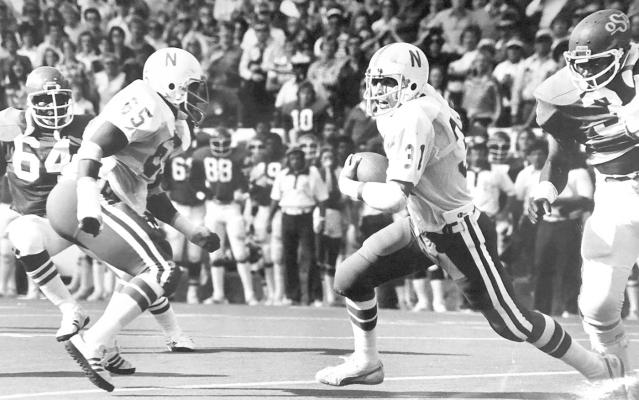
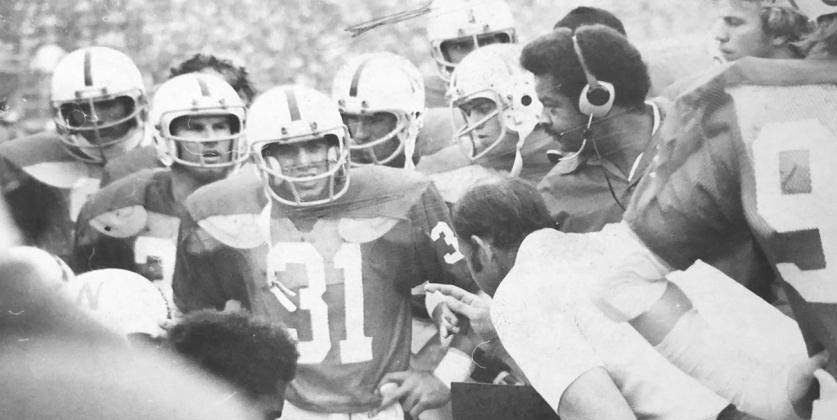
A three-sport athlete, Ted Harvey grew up in Lexington, graduating in 1974 from Lexington High School. He led the Minutemen as a quarterback and running back to two back-to-back state football championships in 1972 and 1973. As the starting point guard in basketball, his team lost by one point in the state championship game and he ran on two gold-medal relay teams as Lexington won the Class B team title.
Harvey, at 5-foot-9 and 140-pounds, wasn’t big, but he was fast and agile. His speed was one of the main reasons Nebraska and coach Tom Osborne recruited him to Lincoln.
“I was a sprinter in high school, so it was up to me as to what position I would play in college,” Harvey said. “Coach Osborne liked me as a wingback or cornerback. Back then recruiting wasn’t a big deal. I heard that there were coaches in the stands during my high school games and then Coach Osborne visited my home after the season. That was pretty much it.”
Harvey visited Colorado and Air Force and heard from some Midwestern schools like Iowa State, but he knew all along he wasn’t going anywhere else but Nebraska.
After arriving on NU’s campus, Harvey began practice at wingback but that didn’t last long after a conversation with Osborne about moving to the defensive backfield.
“I liked the safety position better,” Harvey said. “They could read the eyes of the quarterback and break on the ball. Cornerbacks have to cover the fastest receivers and turn and run with them with their back to the ball and also everyone sees every mistake you make at cornerback. But the coaches thought I was a better corner because I had 4.4 speed (in the 40-yard dash).”
Like most freshmen in his class, Harvey played on the freshman team. The exception was Monte Anthony who went directly to varsity. Anthony’s 651 yards rushing and seven touchdowns led NU in 1974.
“I think he was the first true freshman at Nebraska to play varsity,” Harvey said. “He was a grown man as a freshman and they needed help at running back.”
Both Harvey and Anthony, who was from Bellevue, were Nebraska kids – an important part of what made the Huskers into a national football power.
“For the Nebraska kids on the team, it is more than football, it is home and you always fight for your home. That attitude helps your team culture,” Harvey said.
Harvey became a contributor in 1975 for the varsity. He was a back-up cornerback and played on special teams. The Huskers were national title contenders all season and rose to No. 2. A loss to Oklahoma in the last game of the year shattered their dreams of going to the Orange Bowl and playing for a championship. Losing to the Sooners became a frustrating theme for Harvey during his time at NU.
“Our nemesis was always Oklahoma and the winner of our game went to the Orange Bowl. I feel we tried too hard against Oklahoma, our coaches overcoached and we didn’t play loose,” Harvey said. “(OU’s) quarterback was Thomas Lott who wore the bandana. We all wanted to get that bandana but couldn’t catch the guy, he was slippery and fast. They had a ton of good players.”
The best chance Harvey and the Huskers had to beat the Sooners was his junior year in 1976. But it was the game where “Sooner Magic” was born.
With NU leading 17-13 with 3:30 left in the game, Lott handed off to his tailback who surprisingly pulled up and threw a 47-yard bomb to split end Steve Rhodes. It was the first pass of the day for the Sooners.
Then came the infamous flea flicker. On third and 19, quarterback Dean Blevins passed to Rhodes who lateraled to Elvis Peacock coming around the left side. Peacock ran all the way to the 2-yard line and then scored on the next play with only 38 seconds left in the game.
“Not beating Oklahoma made it tough on Coach Osborne,” Harvey said. “I heard that if we didn’t win our bowl game that year against Texas Tech then Osborne would have been fired. That’s how close Nebraska was to firing one of the all-time great coaches in college football.” Those Osborne teams of the mid-’70s sometimes get overlooked because NU never beat Oklahoma from 1973 to 1977. But during that span, NU lost only one bowl game and always finished in the top 10.
“I think after Bob Devaney stepped down after 1972, it took awhile for Coach Osborne as a head coach to get back to that level, but he finally beat Oklahoma the year after I left (in 1978) and ended up winning three national titles,” Harvey said.
Osborne was chosen by Devaney to take over for him as head coach, a move some of the other NU assistant coaches were not happy about.
“My defensive backs coach Warren Powers and defensive coordinator Monte Kiffin were hoping to get the head coaching job,” Harvey said. “And when they didn’t they decided to move on after my junior year.
Powers became the head coach at Washington State and in his first year, brought his team to Lincoln and upset the Huskers 19-10 in 1977. It was the first game of Harvey’s senior year. “They had ‘The Throwin’ Samoan’ Jack Thompson at quarterback who later played in the NFL and Brian ‘Machine Gun’ Kelly at receiver who set records in the Canadian Football League.”
Of all the games for Harvey, that loss to Washington State was the most disappointing. It was challenging for him and the defense facing not only a formidable passing offense but to do so with a new defensive scheme.
“I felt bad for our team because we had to start over with a whole new system my senior year after Powers and Kiffin left,” Harvey said. “Lance Van Zandt took over as DC and defensive backs coach. He liked more of a man-to-man coverage scheme as opposed to the zone we had been running. We were trying to play bump-and-run man coverage in that first game. I gave up a couple of passing touchdowns and was really upset about that.”
It was a bittersweet season for Harvey in 1977. Besides the loss to Washington State and his former coach, Harvey had to leave the Oklahoma game at the end of the year because of a shoulder injury and had to have surgery. But he garnered the following accolades on and off the field which embodied a model student-athlete: >> 1977 Honorable-Mention All-American >> 1977 First-Team Academic All-American >> 1977 Second-Team All-Big Eight >> 1977 Academic All-Big Eight >> 1977 NCAA Post-Graduate Scholarship Harvey was a biology/pre-med major at NU and after graduating had to make a decision between dentistry or optometry school. He also had NFL teams sniffing around and thought about continuing his football career professionally.
In the end, Harvey didn’t feel up to pro football physically with his shoulder, so he decided to go for the sure thing and attend Ohio State’s optometry school. He later received his doctorate degree in 1982.
After school, Harvey came back to his hometown of Lexington and has been an optometrist with Lexington Family Eyecare for the past 41 years.
“I wanted to come back to Lexington because I like this size of town,” he said. “It is a Class B school and I wanted my kids to play multiple sports. It is a neat community and I just love the place.
“It has changed since I grew up here,” Harvey continued. “We have a lot of immigrants living here now. I enjoy talking to them when they come in as patients hearing all their neat stories where they came from and how they got here to Lexington.”
Sports have also changed in the town. Football and basketball are no longer the dominant programs they were when Harvey starred on those teams in high school.
“Our football and basketball teams have not been very good because a lot of the kids did not grow up playing them,” he said. “But we go to state every year in soccer and are good in individual sports like wrestling and cross country.”
Besides giving back to his hometown community in the medical profession, Harvey has shared his knowledge for the past 13 years as a volunteer coach for the high school football team where his son, Jake, coaches.
Now 68, Harvey is enjoying his first year of retirement. “I lived on a schedule for 41 years and can’t even go to a funeral without rescheduling 20 patients,” Harvey said. “My wife, Kelly, and I want to spend more time doing things together like visiting our daughter, Ashley, and grandkids in Kansas City.”
But Harvey has no plans of leaving Lexington. He said he can’t see himself living anywhere else. He’s the epitome of a Hometown Husker.