

With Decreasing Volunteers, EMTs Hope to Share Resources
There is a shortage of volunteers and nowhere is it felt more keenly than in the ranks of EMS units and fire departments in rural and small-town America. A group of EMS captains in Custer County have come up with a proposal to help.
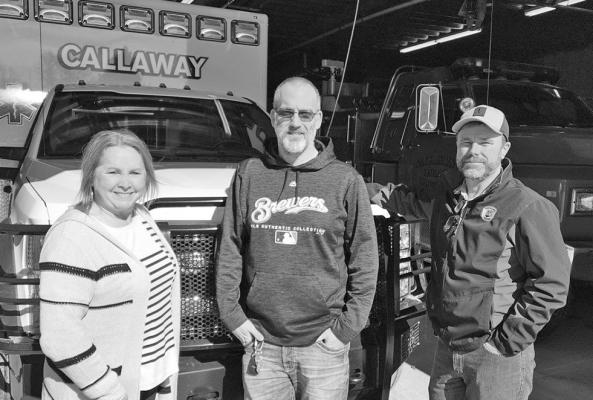
Members of the Custer County EMS Mutual Aid Organization recently talked to the Custer County Chief about their proposal to use interlocal agreements between county EMS units to share resources and, most importantly, personnel. Ansley Rescue Captain Gail Reed, Callaway EMS Chief Mark Buss, and Tammy Weinman, Arnold Rescue Captain, were joined by Custer County Emergency Manager Mark Rempe in explaining how the proposal would work.
In a nutshell, interlocal agreements would allow EMTs to respond to calls in each other’s jurisdiction. If an EMT happens to be in another department’s jurisdiction when there is a call, that EMT could respond immediately, something they currently cannot do.
For example, if an emergency happens in Arnold, Callaway EMTs cannot respond until Callaway has officially been called for mutual aid. Likewise, if an EMT from Callaway happened to be in Arnold, they could not assist until the official request for mutual aid had been made. “You can’t step in,” Rempe said. “You have to be mutual aided.”
The reason behind this is licensure, liability, and insurance. If, however, Arnold and Callaway had an interlocal agreement, that would resolve liability and other issues. The Callaway EMTs could assist in Arnold immediately.
On Feb 28, there will be a meeting to explain the proposal. All county EMTs will be invited along with members of county fire departments.
“The process will be explained,” Rempe said. “We want to get it out to the public. We want to share the vision.” EMTs who are interested in participating can find out how to be a part of it.
Rempe went on to say, “I’m all over the county with this job. I may be right there when something happens. This explains why I can not help them. Licensure says I can’t. This (interlocal agreement) will make it so that if you’re in the area, you can help.”
Asked about the Good Samaritan Law which protects citizens who attempt to help during an emergency, Rempe said, “The Good Samaritan Law doesn’t apply to EMTs.”
It’s believed that the interlocal agreements between EMS units could speed up response time by as much as six minutes or more. Currently, mutual aid calls are issued every five minutes. If a situation is larger than one department can handle, or there aren’t enough people in one department who can respond, 911 dispatchers issue mutual aid calls at five-minute intervals. “It could be even faster,” Reed said. “It could save the original agency a lot of time.”
When asked what the monetary cost would be, the answer was “Zero.” The software to make it happen, IAmResponding, is already in place. According to Rempe, the Board of Supervisors bought it two or three years ago. It is available to any first responder, including law enforcement, who would like to install it on their phone.
The groups said that EMTs and other first responders already carry radios and pagers to keep informed if there is an emergency. However, the software will enhance that. With the assistance of the 911 dispatchers, additional information can be pushed out to the responders. In turn, those receiving the message can let the dispatchers know if they can respond, if they are already in the area, or if they are unable to respond.
The group spoke highly of the 911 dispatchers. Reed said, “The county dispatchers make things like this possible. Without them, this collaboration wouldn’t be possible.”
Fire departments would be involved as they work closely with EMS. Ideally, to answer
cont. PAGE 4 EMTs an EMS call, there should be one driver and two EMTs. State protocol does allow for only one EMT. However, often more people are needed.
“EMS often has to rely on fire departments for drivers or to help with lifting patients, or with equipment. They are a valuable resource” Reed said. “If you have to lift someone, you want to have four to six people.”
There are a lot of reasons why there are fewer volunteers for EMS. “It’s not just Nebraska,” Weinman said. “It’s all over.”
Reasons are as varied as there are people. For many, it’s just assumed that someone else will do it. There have been several retirements locally. There is more mobility in society; with people moving into communities, they may not be aware of the opportunities.
One of the biggest barriers seems to be the training and additional requirements of licensure, certification, and maintenance. “It’s quite a bit,” Buss said. Weinman added that it can be the equivalent of two semesters of college.
Could the proposed interlocal agreements encourage more people to volunteer?
Rempe thinks so. “If this works, you might see some people more open to the idea of volunteering, saying ‘I can help.’” Reed agreed. “Someone might think, ’I’m not home enough hours,” but this gives someone the opportunity to serve where they work.”
The group has already had preliminary meetings with some rural fire boards, hospital administrators and medical directors, county supervisors, and city administrators.
“It’s been received well,” Rempe said. The meeting on Feb. 28 is to share more information on how it would work. Rempe emphasized that the proposal is not aimed at taking local control away from EMS units. “The main goal is to help the citizens who need help,” he said.
He added, “If this is put into place, it doesn’t mean we’re going to stop talking. There can always be something better, we’re always growing and changing.”