

Why The Racoons, Foxes...And Mink Crossed The Road
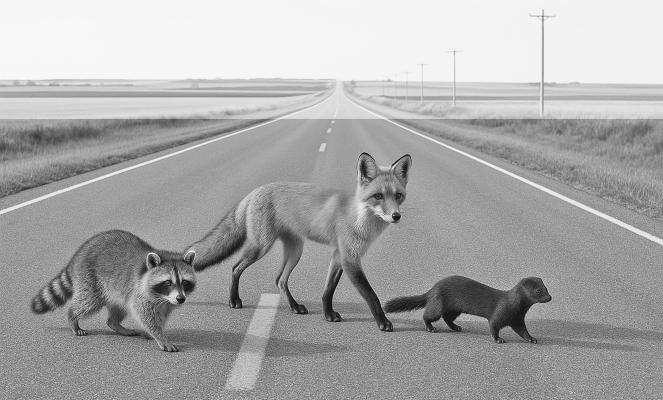

It is that time of year. A number of young animals are dying on the roads and highways. I drove to Cozad the other day and saw four dead young raccoons, two dead young foxes, and an opossum. Why? They are out of the home burrow and making their way into a very dangerous world for the first time.
The young can’t stay in the same territory as their parents for long because they would soon overpopulate the area, so they begin to strike out and explore new locations. Too often those new locations are on the other side of the road. We don’t know why the chicken crossed the road, but we have a pretty good idea why raccoons, foxes, opossum, and mink do.
I didn’t see any dead mink on the road, but I saw six live ones. Mama was leading five young from the south side of Highway 30 to the north. They didn’t dilly-dally and all made it with time to spare. Mink are mammals that belong to the family Mustelidae, which refers to the fact they have a pair of anal scent glands that produce “musk”. Yep, they stink. Mustelids are the largest family of mammal carnivores with 56 species worldwide and six here in Nebraska.
Other than the mink we have badgers, river otters, least weasels, and long-tailed weasels. Occasionally we have short-tailed weasels also called stouts. Another member of the group that was once found in Nebraska is the black-footed ferret. Skunks, while they also stink, are not mustelids.
During the mating season in the spring, mink, which are normally solitary, will tolerate each other and both males and females have multiple mates. The young are born 51 days later, and the female takes care of them alone. The young mink stay with the mother until mid-winter. They feed mainly on water-related animals…there are no vegetarian mustelids. They mostly feed on frogs, salamanders, fish, crayfish, muskrats, mice, voles, birds and bird eggs. They can and will kill rabbits.
A larger relative of the mink is the river otter. River otters were trapped in Nebraska until they were extirpated by 1916. After reports of river otters showing up in various locations around the State the Nebraska Game and Parks Commission decided it was once again safe for them, so they developed and implemented a reintroduction program. Using otters that were trapped in Louisiana and Alaska, 159 individual otters were released at seven locations. By 2016 there were more than 2,000 verified sightings of river otters in Nebraska.
A similar fate almost happened to the mink. They were also trapped and their numbers dropped. However, few people trap anymore and things like the mink, river otter, bobcat, and other fur bearing mammals are making a comeback.
The mink now used in the fur industry are mostly raised on “fur farms”. While there has been a fairly strong movement to end fur farming in the U.S., we are still the largest exporter of fur in the world. Russia is the largest importer of fur. Concerns of the fur farming are similar to any livestock farm, but a new concern has risen. Because there are so many individual mink living together in a relatively small area, there is the fear of a zoonotic disease arising in the mink, which then mutates and infects humans. This concern has increased because of the COVID-19 pandemic that was originally thought to be a virus that jumped from bats to humans. We now know that it didn’t, however, SARS did.
Mink trapping is legal in Nebraska but there are not that many trappers so if my five little mink that scurried across Highway 30 can keep from getting run over like the raccoons, foxes, and opossums, chances are they will grow to maturity and produce little mink of their own.