

System Transition Will Require Patience From The Patients
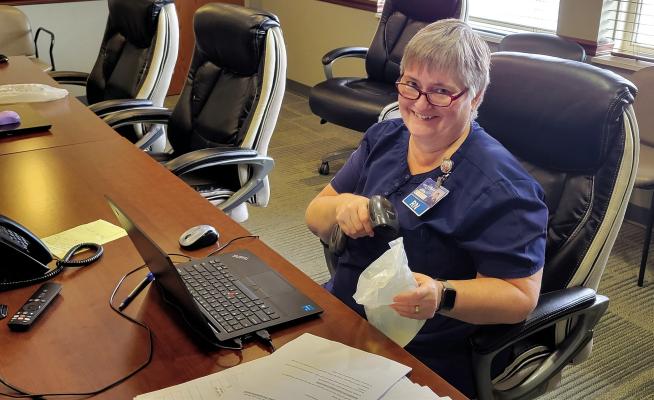
It may be a small rural facility, but Callaway District Hospital takes great pride in providing the most innovative technology and care available for their patients. That is why the dedicated staff has spent more than a year preparing for a transition that will improve patient care and all services the entity offers.
A little more than a year ago the hospital was notified by their current software company that the product the facility was using was going to be phased out, and that they had about a year and a half to make the conversion to another product. “Brett and I spent many months involving the hospital staff in researching a product that would meet our needs, and most importantly, the needs of the patients,” explained Caleb Poore, CFO of Callaway District Hospital.
The product being discussed is a health medical records (HMR) system, and Poore said all of their research narrowed the field down to three companies and ultimately to Cerner. The hospital has spent the better part of a year implementing that product.
“It’s been a bumpy journey and has had a lot of challenges. But the staff has seen, and we see, that this will be far superior to any product that we have had in the past,” said Poore.
A “go-live” date for the new Cerner system has been set for April 17. On Sunday, April 16 at 11:59 p.m., the switch will be made from the current EMR (electronic medical record) system to the Cerner system.
“EMR is the software that runs hospitals, therapy clinics, outpatient clinics - basically any software that is electronic is an EMR,” explained Poore.
He said the electronic medical record system was enacted by the Health Information Technology for Economic and Clinical Health (HITECH) Act passed by the Obama administration in 2009. The government realized that it would be prudent to transition from paper to electronic medical records. In 2012, Callaway District Hospital adopted the Centriq program and had been with that vendor for nearly 10 years when they were notified that the company was sunsetting that product.
“These EMRs control everything, from supply management to patient care, documentation, our financials, inventory with medications - the whole bit from A to Z,” said Poore. “It is a critically important asset of the hospital and one that we use to manage the patient care of our facility.”
Poore said that the new system will bring with it many nice perks for the facility, including the ability to communicate with patients regarding preventive visits and wellness checks. “It will help us understand when our patients need those things to keep them out of the hospital, and more healthy in the community.”
The new system will track things such as patient screenings and immunizations, which most software programs do; however, the ability for the facility to pull that information out of the system is what separates good EMRs from great EMRs, Poore added.
While the staff and administration is excited to finally make the transition and see the reward of their yearlong effort, Poore and hospital CEO Brett Eggleston want to make the public aware that their help and patience will be needed during this time.
“We are bringing over a limited amount of data from the old EMR into the new system, and there are a couple of reasons for that. First of all, there is a limitation on what we can bring over, and secondly some of the information that we could bring over was outdated and we didn’t want to mess up the system,” said Poore.
Eggleston compared it to a reset. “We are bringing across the basics - your name, address, phone number and those demographic things. If we have to go back and look up lab results from a patient from three years ago we have the ability to do that, but we are not going to bring all of that information into the new system and clutter it up,” he said. “The new system will be a fresh record moving forward.”
The bottom line for patients of the hospital and clinic is - how will this impact me? The administrators shared that they believe patients will feel more of a sense of engagement with this new EMR that they did previously. “It will allow the staff to take a more in-depth look at what things are upcoming and what they can do personally to improve your quality of life,” Poore added.
In terms of the things the patients can see with the new system, Eggleston said one of those is that the registration process will look a little bit different - at least initially. “As we are rebuilding that database it is going to take a little bit more time to get patients registered. So how do we combat that and make sure we stay on schedule? We are asking patients to please come in a little bit early to get checked in,” said Eggleston. “In time that will get better, but we are learning a whole system at the same time we are recreating this information. So patience from the patients is what we are asking for.”
The clinic will also be scheduling more time for appointments to allow the providers additional time to complete their tasks. “Initially that may mean it might take a little longer to get in to see your doctor, because there aren’t as many appointment slots open,” said Eggleston. “Again, that will improve as we get more comfortable with the system.”
Another big thing the patients will notice is the online portal, which will have a whole new look and feel. Unfortunately, however, patients will have to sign up for a new account for the portal as the old accounts will not be able to transfer over. The statements will also look different, and will all now be generated from a third party vendor.
“The new statements will be a lot easier to read than what we have now, and will give patients a lot more detail. So hopefully that will cut down on questions,” said Eggleston. “Initially people will see an old statement from the old system, and a new statement from the new system. But they are not being double billed. If a patient had a visit before the conversion and a visit after the conversion, they are going to get two bills from two different places. But they are not being double billed.”
Another advantage patients will see with the new system is reminder text messages, if they opt for those reminders. “It’s just a simple thing that we are adding to improve the patient’s level of care,” said Poore.
The EMR system interconnects every department and staff member within the hospital. “All of the radiology equipment has to be able to ‘talk’ to this system and send and receive reports. The same with the lab equipment,” Eggleston explained. “There are all of these little interconnected things that have to get switched over, and that is why it is such a huge project. And you have to be 100% accurate. Our staff has been phenomenal! Truly the success of the project lies with the staff.”
“This software literally runs the hospital,” Poore added. “This has been a huge undertaking.”
There were 24 hospitals within the state of Nebraska using CPSI Healthland Centriq, and all 24 of those have elected to transition to Cerner. “That is really going to help healthcare in Nebraska as a whole become streamlined and more efficient,” Poore added. “When most people go to the doctor they don’t think about all of these things, they just want to be seen and taken care of. That is our goal at the end of the day - to just take care of people.”