

‘People should be able to compete’
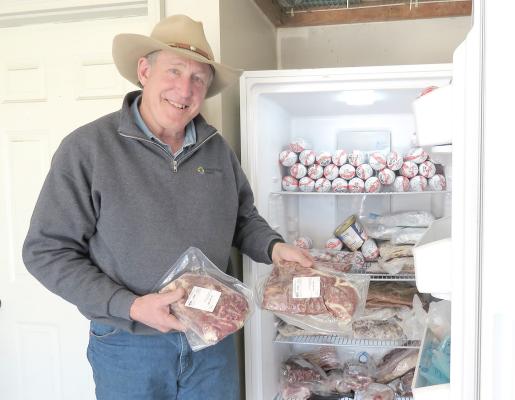
From the respite of his Callaway office, after a cold January day spent working cattle, Jim Jenkins wrangled with a question: Do you think much about meat products cultivated from cells?
“No, I don’t,” he answered. “Maybe I should.” After researching, he made up his mind: He’d be very surprised if “lab meat” could compete on quality or price with Nebraska beef – like what comes from the Angus he raises – in the near future.
Just days earlier, Gov. Jim Pillen made it clear he did not want to wait to find out. Nebraska, he said, needed to “get on the offense.”
The governor, who founded one of the largest hog enterprises in the country, said the state needed to protect its farmers and ranchers, a critical piece of Nebraska’s economy and identity.
“Most of us want government out of our hair, but there’s places where government needs to step in and protect us,” Pillen said at a mid-January press conference announcing a bill to ban the production and sale of “cultivated-protein food products.”
It’s unclear if a ban, which Pillen named a priority for the current legislative session, has enough support to become law. The senator behind the bill, Niobrara farmer and rancher Sen. Barry DeKay, said he expects a fierce debate.
The Nebraska Farm Bureau and Nebraska Cattlemen support clear labeling, but not a ban. Jenkins falls into that camp.
“In the good old United States of America, I think people should be able to compete, even if that threat-
cont. PAGE 6: Lab Grown Meat 1, and lost by fall in consolation round 2 to Logan Lichtenberg of Neligh-Oakdale.
120 - Josiah Coleman won by major decision over Mason Sutton of Sandhills/Thedford in round one, 14-6. In the quarterfinal Coleman lost a nailbiter by 1 point, 14-13, to Colter Sinn of Thayer Central to drop down to the wrestlebacks. In consolation round 2 Coleman won by tech fall over Timothy Hittner of Fullerton, then won his next consolation match by a 2-1 decision over Dylan Furstenau of Neligh-Oakdale.
That put him in the consolation semifinal match often referred to as the heartbreak round - with the winner advancing to state. For Coleman, the round truly was a heartbreaker as he lost by 1 point, 7-8, to Ora Chaffin of Burwell.
165 - Paxton Bierman lost his first-round by tech fall to Kyle Knueven of Giltner/Harvard, then came back to win his first-round consolation by fall over Breckstyn Stretch of Nebraska Christian. Unfortunately, Bierman lost the second-round consolation by fall to Jacob Jackson of Franklin.ens my business,” he said.
Meat, grown in a bioreactor Opponents like Pillen call it “labgrown” and “bioreactor meat.”
Others call it “cultivated” or “cellbased” or “cultured.”
Likewise, some don’t agree that protein products grown from cells should be called “meat” at all. Mark McHargue, president of the Nebraska Farm Bureau, said in a statement that they “should not be classified as meat.”
But unlike the plant-based imitations some fast-food chains have added to their menus, these products do originate from animals, though animals aren’t slaughtered in the process.
Instead, scientists take cells from an egg or live animal like a chicken or cow. They put select cells into a bioreactor with liquid and add nutrients like amino acids, vitamins and salt that mimic the environment in an animal’s body, according to researchers and companies making the products.
The cells multiply and eventually form a substance that can be shaped into something familiar like a ground meat or filet.
To date, only two cultivated meat products – both poultry – have made it through the U.S. approval process. Neither of those are intended for full-scale commercial release, said Suzi Gerber, executive director of industry lobbying group the Association for Meat, Poultry and Seafood Innovation. They were intended to generate excitement.
“Cell-cultured” meat products are subject to the same federal regulations and oversight as products made from slaughtering animals, according to a 2023 federal directive. The U.S. Department of Agriculture must approve product labels to ensure they’re not misbranded.
Gerber and others in the industry tout cultivated meat as part of a solution to climate change and a tool to address food insecurity for a growing global population.
“We do not envision a world where meat production ends. … We see cultivated meat as a complement to existing food systems” Gerber said.
Some meat heavyweights seem to agree, or are at least hedging their bets. In recent years, major corporations like Cargill and Tyson have invested in it. According to the Good Food Institute, cell-cultured meat and seafood companies had raised $3.1 billion as of 2023.
In the last decade, technology has advanced and the cost of production has gone down, said David Kaplan, director of the Tufts University Center for Cellular Agriculture. That will continue but the biggest challenge, he said, is the scale-up.
“Right now there’s just not the infrastructure to have this field grow, to start to produce enough food to be in supermarkets for people to really purchase and then cook and try,” he said.
Nebraska eyes a ban
Pillen first took action last August, signing an executive order demanding that state agencies not procure labgrown meat and that state contractors attest they won’t “discriminate” against traditional meat producers in favor of “laboratory or cultivated-meat producers.”
This session, senators have introduced at least two bills related to these products: a total ban and labeling requirements.
If the ban passed, making, importing, distributing, promoting, displaying or selling a “cultivated-protein food product” would be a violation of the Nebraska Pure Food Act – which can result in an order to stop, or even a misdemeanor charge.
The industry Pillen is attempting to shield represents a significant chunk of Nebraska’s economy. In 2022, agricultural production and processing industries made up almost 11% of Nebraska’s total GDP, according to an analysis from the University of Arkansas. Cattle and calves were the state’s top agricultural commodity.
Sen. DeKay, chair of the Agriculture Committee, said he’s on board with the governor’s proposal because he wants to ensure the products’ safety. Constituents, including individual beef producers, have told DeKay they support the ban, he said.
“There’s going to be vigorous debate on both sides of this,” DeKay said. “And then we’ll put it out and see what we need to do to get a final product across the finish line with this bill.”
The governor’s office declined to provide the names of any organizations supporting the effort.
The Nebraska Farm Bureau supports transparency, proper labeling and a prohibition on using taxpayer money to buy or research the products, according to a statement. But it doesn’t support state-level bans.
Nebraska Cattlemen also “does not support an outright ban,” according to a press release, but supports labeling requirements.
The Nebraska Pork Producers Association is still working on the issue, according to Executive Director Al Juhnke.
Co-sponsor Sen. Myron Dorn, who raises cattle, said his endorsement had less to do with banning the products and more to do with showing support for Nebraska’s livestock industry and starting a conversation.
Both bills were scheduled for public hearings Feb. 18. Pillen spokesperson Laura Strimple said the governor is “always open to discussing changes to legislation.”
If Nebraska does pass a ban, it may run into a legal fight.
Florida, which passed a ban last year, is fighting off a lawsuit from cell-cultured meat company UPSIDE Foods, which argues the law is unconstitutional.
“I think the case in Florida would have implications for any state law that purported to ban cultivated meat or poultry,” said Paul Sherman, lead counsel on the case.
Impacts uncertain
If a cell-cultured meat product existed that was indistinguishable from conventional meat, would you try it?
Robert Hutkins, retired food science and technology professor at the University of Nebraska-Lincoln, used to pose that question to students. Consistently,about half answered yes. Some students came from ranch families.
“The beef industry is huge in Nebraska,” Hutkins said. “It drives our economy – between corn and soybeans and beef – and so there's no doubt that that attachment is very real and very important.”
It’s not yet clear how this technology might impact traditional agriculture here, said Nicole Tichenor Blackstone, a sustainability scientist in the Tufts lab.
She and other researchers are working on a grant-funded project that will include talking to meatpacking workers and cow-calf producers in Nebraska. The goal, she said, is to dig into this early “so that the technology can be developed responsibly.”
Tim Chancellor, a Broken Bow hog producer and past president of the Nebraska Pork Producers Association, is among those not worried about “lab-grown and artificial substitutes.”
“I’m more focused on the safe, tasty product that we produce,” he said, “and putting it out to the people to let them make a decision.”
The Flatwater Free Press is Nebraska’s first independent, nonprofit newsroom focused on investigations and feature stories that matter. Learn more at flatwaterfreepress. org