

Now is When The Days Start Getting Longer
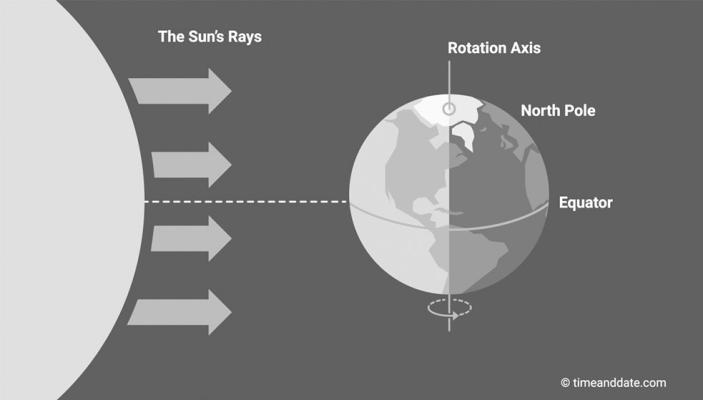

Last Thursday it was the lunar eclipse and now today (Thursday the 20th) it is the Vernal Equinox, also called the Spring Equinox. As most know, this is the time when the number of minutes of daylight equals the number of minutes of darkness, at least on the equator. For those of us in this area of Nebraska, because we are a long way north of the equator, the “equinox” was Monday the 17th at which time the sun rose at 7:49 A.M. and set at 7:49 P.M.
The “official” equinox occurs when the sun is directly above the equator. There is a myth that at that moment you can balance a raw egg on its end. The exact moment of the “official” spring equinox was at 4:01 A.M. this morning so your chance to do so has passed. Actually, it is a myth. You have just as good of a chance to balance an egg every day of the year! From the equinox onward to the Summer Solstice the days will continually get longer and longer as the sun appears to move a little further north each day.
All over the world people historically marked four very important dates. The spring equinox was used for thousands of years to mark the beginning of the year. The summer solstice was a time of celebration as it marked the mid-point in the growing year. The fall equinox was the time of harvest, and the winter solstice marked the end of things getting colder. For thousands of years people have observed these days, and even built monuments to them, but they didn’t understand why they occurred. Much was left to the “gods” and multiple mythologies.
Enter Hipparchus. He may have been the greatest overall astronomer of all time, and he is known as the “Father of Astronomy”. He was born 190 B.C. and died in 120 B.C. In addition to being an astronomer, he was a mathematician.
A couple of his accomplishments were the invention of trigonometry. He needed a way to calculate the orbit of the moon and Euclid’s geometry wasn’t quite up to the task, so he developed an entirely new kind of math. This also allowed him to determine when eclipses would occur. Lastly, relevant to today, he was the first to explain the concept of the equinox.
It had long been recognized that the earth is tilted 23.5 degrees away, or toward the Plane of the Ecliptic. This “plane” is the apparent path of the sun through the sky. Hipparchus believed the earth was static and the sun revolved around it. Thus, at one point in the year the 23.5 degree tilt was toward the sun, the summer solstice, and at another point it tilted away…the winter solstice. Halfway around from one to the other was the equinox. His concept was absolutely correct; he just had the wrong heavenly body revolving. We now know it was the earth moving not the sun.
He then measured the “solar or tropical” year, missing it by only six minutes. That gave him enough information to start to predict where the sun and moon would be anytime in the future. This, plus work done prior to Hipparchus, is what allowed Columbus to know that a total lunar eclipse was coming, and he was able to use that knowledge to intimidate the locals into becoming servants of Columbus and his men.