

New Life For Old Church: History Surrounds Callaway Lutheran
*EDITOR’S NOTE: Just weeks before his passing in September 2025, Cecil Woodward, one of the founding members of Callaway Lutheran Church, shared his knowledge of the history of the church with me for this purpose. Cecil understood the importance of preserving the stories and history of our communities and families for future generations. Last week we recounted the story behind the founding of the revised Callaway Lutheran Church 50 years ago. This week, we continue that story.
A 50th anniversary is a big deal. What makes the anniversary of Callaway Lutheran Church most notable, however, is not necessarily the 50 years of its current service but rather, the story of how it came to be in the first place.
Cecil and Hazel Woodward, along with about 20 others from Callaway and the surrounding area, joined together in about 1970 with a common goal to either start or reopen a Lutheran church in Callaway. After sharing a building with the local Episcopal Church for a few years, the majority of the Lutheran members felt it was time to have a building of their own. When the Village offered to practically give the group the EUB church that had been donated to the Village by Doc and Rhoda Chaloupka, who were married in the church in 1948, it appeared they had found the answer they were looking for.
So a property was purchased by the group on the south side of town that included a small house. The house was demolished and the lot cleaned up in preparation for the former EUB church to be moved there. Then, the work began on the old church.
“All the plaster was removed from the walls as they were crumbling,” Cecil Woodward recalled during a September 2025 interview. “And it would make the building lighter to move.”
Cecil said moving the building was a community effort, one in which the entire town of Callaway got involved in, along with folks from the Finchville area, Lodi area, and members of neighboring churches.
“Oscar Andersen, who was 77-years-old at the time, was in charge of the move,” Cecil explained. “Bill Lynch helped by pouring the cement footings, and many townspeople helped during the move of the building with getting past wires and branches. Once the building was set on the foundation, townspeople would stop by after work to begin repairing the inside of the church. People throughout the community would donate a couple of hours at a time.”
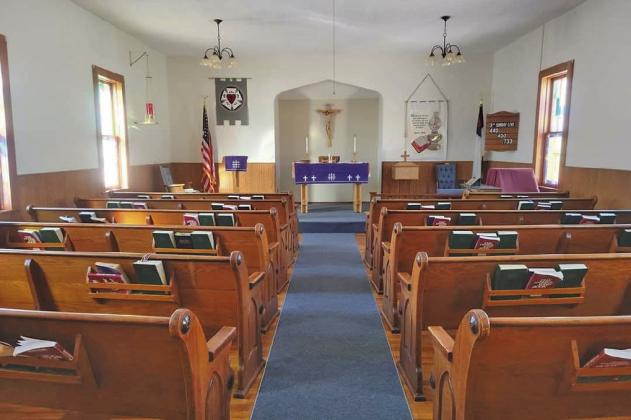
The church had no furniture or items needed to conduct a service, so Cecil and Hazel commissioned Robert Hoesel to build a lectern. The Woodwards purchased the wood, “And Robert was good at woodworking,” Cecil added.
Larry and Linda Mowery donated wood and paid to have Hoesel construct the altar, and Don and Vi Henry bought the candelabras. A baptismal font was also donated to the new church.
The next requirement was seating, and the congregation became aware of a Lutheran church in southeast Nebraska that was buying new pews and offered to donate their old pews to the Callaway church.
“Don Henry was taking his cattle to market. After he dropped them off at the Omaha Stockyards, he drove to the small church to pick up the pews in his livestock trailer. Once he got them to Callaway, several people came to unload the truck and wash all the cow poop off,” Cecil recounted with a chuckle.
Cecil also shared the story of Evelyn Gladium, director of the Callaway nursing home at the time, who recalled one day that G’Schwinds had donated the communion set to the original church which had been sold and moved to Thedford.
“She (Gladium) picked up Larry Mowery and told him they were off to Thedford to get the communion set back. The pastor tried to say the set went with the church, and she asked him if he even knew the G’Schwinds. He said no, and Evelyn said, ‘Well I do, and the church does. They purchased it for our church.’ So she got the communion set returned to the church.”
Another Lutheran church had donated their old outdated hymnals, and with all of the necessary items in place, the new Callaway Lutheran Church was ready to conduct services. “You had to remember to use the bathroom before church though,” Cecil added. A stipulation by the Chaloupkas upon donating the building was that no changes could be made to the interior of the structure - and the church was so old, there was no bathroom.
So, the congregation began making plans to construct a learning center and bathrooms in a separate building next to the church. Cecil said the wood for the Learning Center and reception hall came from an old barn that belonged to Duane and Kate Henry. The hall sat empty for a while, as there were no funds available to furnish it.
Once again, Cecil jumped into action and began having church and community members dump their aluminum cans into the back of his pickup. He would then crush the cans and haul them to the recycling center, where the price for cans at the time was 66 cents a pound. The profits were then used to supply the hall with appliances, a coffee maker, toaster, dishes, tables, and chairs.
Little Church in The Middle of The Road Cecil had become acquainted with a retired lawyer, Philbert Cornish, who had moved to the Broken Bow area and was serving as Callaway’s city attorney while helping some of the people in town with less complicated cases. “One day after helping me out with a small legal matter, Philbert asked if I knew the rest of the story about the church building,” Cecil recalled.
Philbert shared that he had grown up in the church, which was originally located on a corner in Finchville - a small town located between Callaway and Oconto. He told Cecil that at some point the congregation had become split about the location of the church.
“So one night half of the congregation showed up at the church in the middle of the night. They jacked up the church and put wheels under it,” Cecil recounted as he recalled the tale Philbert had shared with him. “They started rolling it down the road. At sunrise, the church was in the middle of an intersection, and the other half of the congregation was now awake. The move stopped in the middle of the intersection while the groups argued all day. The only decision was that the church would not be moved until everyone could agree. So all summer the church sat in the intersection. An outhouse was built, and they held church with the whole congregation every Sunday.
“By fall, they decided the church needed to be put on a foundation with heat. The building was beginning to sag,” Cecil continued. “So the decision was made to move the church back to its original location and was attended by all the members for many years after that.”
When declining membership resulted in the church's closure, it was sold to Fidelity Church and relocated to Milldale, between Callaway and Arnold, near the Woodward/Rarden property. From there, it was moved to Morgan Park.
“When the church was moved to Callaway, many members from the Lodi area came to help to make sure their church had a good home,” said Cecil. Some of those members included Chuck and Bob Meyers, Bob Pierce, Hazel Pierce, and Philbert and Eleanor Cornish.
This month the church celebrated 50 years of serving the Callaway area, though the building's history runs much deeper than that. It still sits on the property it was moved to from the park all those years ago, and holding true to the wishes of the Chaloupkas, the interior remains the same. A piece of history nestled in the heart of the Seven Valleys.