

LOUP LINES: Brake For Turtles
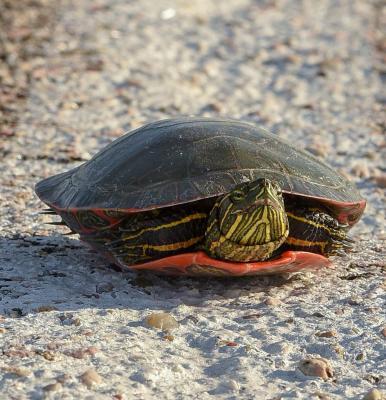
It’s that time of year when drivers begin seeing turtles on Nebraska’s roadways. The highways, byways, and back roads of the Lower Loup NRD are no exception.
What causes a turtle to hit the road? They may be looking for mates, migrating between food sources, or in the case of juveniles – establishing their own territories. But many of the turtles crossing roads in late spring and early summer are females plodding toward nest sites.
Eight of Nebraska’s nine native turtle species live most of their lives in streams, wetlands, lakes, water-filled ditches – and in the case of snapping turtles and painted turtles – even sewer ponds. When conditions are right, adult female turtles leave the safety of their aquatic environment and embark on an overland trek led by instinct and the natural urge to reproduce. If a turtle’s natural migration route takes it across a road, tragedy can strike. Some portions of Nebraska roadways are littered with the fragmented remains of roadkilled turtles. Ornate box turtles once thrived nearly statewide in Nebraska. Habitat alteration has reduced their Nebraska range significantly and now they are most common in the Sandhills. This is Nebraska’s only terrestrial turtle species. Adult males typically have red irises in their eyes. The females have greenish-brown eyes. Those girls lay 2-8 oval eggs that typically hatch about two months later. It took five years – a turtle’s pace if you will – after Nebraskans voted the box turtle as Nebraska’s State Reptile before it finally became official in 2022. Sadly, this distinction is not enough to keep some drivers from intentionally striking the animals. On the opposite end of the turtle size spectrum in Nebraska, the common snapping turtle reigns supreme. Commonly growing to 30 pounds or even larger, hitting this behemoth could do serious damage to a car’s undercarriage or cause a vehicle to leave the roadway.
I was on my way to a wedding years ago when I happened upon two women standing in the middle of Highway 281 north of Bartlett. Dressed to the nines, they were on their way to a different wedding and had been detoured by a big mama snapper. The do-gooders were doing their best to move the turtle. Repeatedly they tossed a sock toward its gaping mouth, hoping the reptile would take hold so they could drag the animal into the ditch. With traffic stacking up, and the best man on track to show up late to his brother’s wedding, I picked the turtle up by the non-snapping end, moved it to safety, thanked the bridesmaids, and drove off.
Snapping turtles are not aggressive. But with a natural fear of humans, they lash out with an impressive display of clashing jaws and slashing claws in self-defense when approached.
The total opposite of the snapping variety, the Blanding’s turtle prefers pulling into its protective shell box turtle-style with a loud hiss rather than biting. The range of this protected species extends from Nebraska to Canada and eastern states and also includes the wetlands, rivers, and associated uplands of the Lower Loup NRD. One of these docile animals was captured as an adult in Minnesota and subsequently marked and released. Incredibly, this same animal was recaptured 77 years later!
These Nebraska natives likely live a century or longer, maybe even 150 years! The truth is that mankind hasn’t been studying them long enough yet to know for sure.
I know from experience that family members will not appreciate you risking your own safety in traffic to move a turtle off the road. Never do that! Experts say when it is safe to do so, and only then, to always move a turtle off the road in the direction it was headed. Otherwise, they will come right back. Remember, these animals are not wandering aimlessly. Also, these are unpredictable wild animals capable of biting and scratching.
Fossil evidence suggests that turtles have been around since before the time of the dinosaurs. These natural wonders certainly do not deserve to meet an untimely end on the asphalt.