
Guthard Part of Callaway LEADership
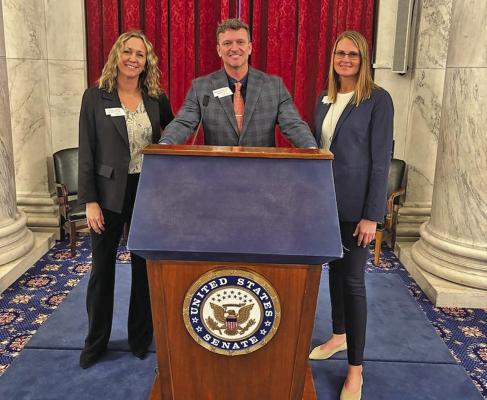
Stacey Guthard of Callaway, far right, is one of three Custer County representatives chosen for the Nebraska LEAD 44 Class. The group recently completed a national study and travel seminar, including a visit to Washington, D.C. Pictured with Guthard are Sarah Zimmer of Mason City, and Brandon Miller of Merna. (Photo courtesy Stacey Guthard)
Being selected to be part of Nebraska’s prestigious LEAD program is an honor and a great opportunity for growth and networking. Several individuals who have been part of the program have called Callaway home, including one of the members of this year’s class, Stacey Guthard.
Guthard is currently serving as a member of the Nebraska LEAD (Leadership Education/Action Development) Program Fellows Class 44. She is following on the heels of another Callaway LEAD Fellow, Lucy Kimball, who is finishing up her stint as a member of LEAD 43 Class. Lucy followed in the footsteps of her father, Duane Kimball, who was also a LEAD fellow. So, you see, Callaway has a strong connection to the program.
LEAD fellows are either nominated by someone else or prospective fellows can apply for a spot in the class. Applications are completed in June, and interviews are done in July, with the LEAD Board making the final decision on who gets accepted into the class. The maximum for a class is 30. The Nebraska LEAD Program is committed to developing leadership potential in Nebraska’s agricultural sector.
Guthard and the rest of 44 Class recently returned from a National Study/Travel Seminar, an immersive educational experience designed to expand their understanding of agriculture, public policy, leadership, and global issues shaping rural communities. The seminar took participants to Kansas City, Missouri, Washington, D.C., Chicago, Illinois, and Moline, Illinois, where the group met with agricultural leaders, policymakers, industry innovators, and community organizations.
Participation in the LEAD program is a big commitment, one that requires consent from the spouse and employer of the applicant, Guthard explained. “The schedule kind of replicates a school year. It starts in August/September and goes through March,” she said.
Many of the program’s participants apply because someone they know was a LEAD fellow. That was the case for Guthard. “My supervisor went through the program, and his supervisor did as well. They recognize the significant value the program provides, particularly through its strong networking opportunities and educational benefits,” said Guthard.
It is a two-year program that entails 12 seminars. The first half of the program focuses on local, state, and national issues, and the second half dives more into the global perspective. The seminars take place on the campuses of Nebraska’s colleges. Guthard said visiting the colleges has been “an eye-opening experience”. Her final two seminars for this year are being held in Omaha and Curtis.
While on their national tour, Class 44 visited the Federal Reserve Bank of Kansas City and participated in an agricultural policy roundtable, attended meetings at 4-H Clover Capital in Washington, D.C., visited industry sites and took part in an urban agricultural discussion in Chicago, and visited the John Deere factory in Moline.
She explained that a very common theme from all the speakers she heard on the national study and travel seminar is the issue of trade and tariffs. “There is an incredible amount of activity happening in the global trade space right now, with countless industries and associations working to strengthen trade relationships around the world,” she said. “It takes years to build the trust and partnerships that support international trade, yet a single tweet or social media post can jeopardize those relationships in an instant. That reality was eye-opening and underscored how rapidly technology is reshaping the way we conduct business globally.”
Guthard is currently the Bank President of First Interstate Bank in Callaway. “My supervisor felt that participation in the LEAD program would help me advance further in my career in the banking world through networking and further enhancing my leadership skills,” Guthard shared. “One thing I enjoyed about the policy seminar in Lincoln was meeting with our senators and learning that they really do want to hear from us. More of us need to rally together and make our voices heard, especially in the ag sector. Our agricultural voice is getting pushed to the back burner, so being heard is more important now than ever.”
Guthard is also very active in the Callaway community. She serves on the board of the Chamber of Commerce and Callaway Good Life Center, and is on the LB840 committee and the Economic Development Committee.
At the end of year two, the Class will go on an international seminar. Kimball and the 43 Class recently returned from an international study seminar that included Morocco and other destinations. Guthard said she will find out when 44 Class reconvenes in the fall, where they will go for their international seminar next spring.
According to the Nebraska Agricultural Leadership Council, “the Nebraska LEAD Program began in 1981 to develop leaders to help shape the future of the state's agricultural industry. The constant changes that occur in agricultural policy, marketing, economics, and technology point to the need for strong leaders to advocate for the heart of Nebraska's economy. Now, in its fourth decade of pioneering agricultural leaders, the Nebraska LEAD Program has evolved into one of the nation's premier agricultural leadership development programs.”
This summer, applications will be accepted for LEAD 45 Class. Individuals between the ages of 24 and 45 who are actively involved in the agricultural sector are welcome to apply. If you are interested in applying or making a nomination, email leadprogram@unl.edu.