
Board Ponders Teacher Vacancy Issue
Program Designed to Meet Needs of Whole Child
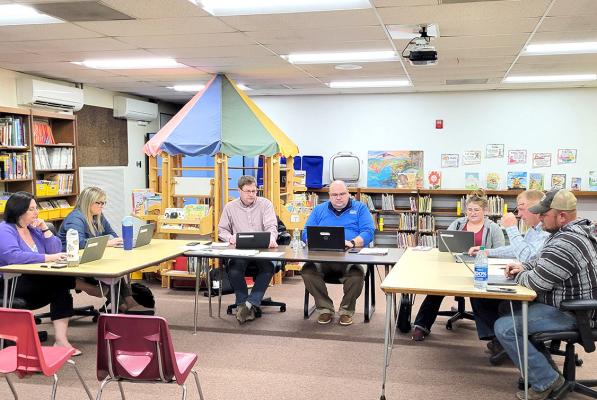
“For the first time since I have been here the teacher shortage is having a negative impact on us.” Those words were echoed by Callaway High School Principal Heath Birkel during a discussion at the April 8 school board meeting.
Birkel was talking about the vacancies created by the resignations of shop teacher Pat Recoy and ag teacher and FFA Sponsor Amanda Chytka. With a shortage of available teachers, particularly in rural areas the administration is weighing their options and trying to determine what is best for the majority of the students they serve.
“To teach ag in Nebraska there are certain requirements that your teacher has to have to teach an FFA program,” Superintendent Bryon Hansen told the board. “There are classes that you offer that lead right into agriculture. The traditional shop program typically is not going to have someone who is licensed to teach those (ag classes) and therefore allow our kids to paritipcate in an FFA program.”
At the heart of the discussion was the question of whether the district could find and afford a teacher for each subject, if the two should be combined under one teacher, or if one of the programs should take priority over the other. “As we look at candidates this position can be a hybrid position,” Hansen stated. “If you look at what we have wanted to do with the shop and some of those classes that are available, they can fit under the agriculture structure.”
There were mixed thoughts from the board on the issue. Because of the shortage of teachers, especially in those two fields, Hansen foresees the district hiring someone on a provisional to teach those classes. “I feel like we have had some interest in it from people who would be fairly solid as an ag-based program.
cont. PAGE 3 - School Programs The key then is to find some of these (shop) classes that fit under that ag umbrella,” said Hansen.
“I think we all got a phone call, at least one, from somebody who is very sure that they want to keep the ag-based direction,” said board member Liana Hrupek.
Board member Rhonda Pandorf also weighed in concerning creating a hybrid position for the two programs. “Pretty much it’s the ag way that we can incorporate some of the shop stuff, not vice versa. We’re a small school and I would be curious to see the male/female ratio when we started our shop classes a few years ago compared to what they are now. I think the route we have gone to attracts more girls,” she said.
Also along the lines of school curriculum, Elementary Principal Brittany Jesseph gave a presentation on Nebraska’s Multi-tiered System of Support, more commonly known as NeMTSS. The technical definition of the system is “a framework designed through the lens of continuous improvement to guide school districts, schools, and all educators to ensure each and every student has access to learning experiences that enhance their educational outcomes.” That’s a mouthful, and Jesseph set to work to explain the idea in simpler terms.
“MTSS really wants this to be a group thing where everybody is involved, not just one or two people. Basically, we need to stop asking if a student is responding and start asking if our current system is working for all of our students,” Jesseph shared. “The NeMTSS framework outlines specific skills and actions to organize, support, deliver, and drive continuous improvement. The NeMTSS framework meets required continuous improvement regulations set forth in Section 009 of Nebraska’s Administrative Code, Rule 10, Accreditation of Schools, and regulation 005.03 requiring accredited schools to have a student assistance process. NeMTSS provides districts, schools, and educators with a structured approach to reaching goals they are already accountable for achieving.”
Jesseph went on to explain that the MTSS vision has an umbrella and everything fits under that umbrella - meaning that we start with a hierarchy of needs and as we continue to learn more and more about learning we are understanding the importance of educating the whole child. Items beneath the PK-12 MTSS umbrella include academics, behavior, and social-emotional, which all overlap in meeting the needs of the whole child.
She outlined some of the benefits of MTSS as: * Framework used to provide support to ALL learners (PK-12) * Promotes an integrated whole child system of general education and special education * Provides early intervention for students who need support to reach their academic or behavioral goals * Uses high-quality, standards-based instruction and interventions backed by research * Addresses students’ academic, social-emotional and behavioral needs * Helps identify students who may need special education The idea is to provide the needed support for any students who are struggling in a particular area. Jesseph explained that the support is offered in tiers, with Tier 1 being all students. Those who may still be struggling a little in that subject would then be given some additional support in Tier 2, and approximately 10% of the students may need intensive intervention in Tier 3. “This is not just for SPED students, this is for ALL students,” Jesseph emphasized.
Callaway Public Schools is already implementing this framework. The MTSS leadership team meets monthly on early outs to evaluate current practices and data. This team includes administrators, some elementary teachers, and some high school teachers. The SAT (student assist team) also meets to discuss individual student’s needs/concerns.
“We have created testing protocols, meeting the SEL needs of students, ACT improvement goals, attendance goals, progress monitoring, WIN time, staff needs/placement, Bear Down Time, Bear Cave, and standards-based grading. These are all things we have discussed in our MTSS meetings and kind of put together to build this framework,” said Jesseph.
She said some of the goals for the future include decision rules made for class allowance - meaning deciding who goes into what class; meeting the needs of all students regardless of level; increasing testing achievement levels; and inclusion of all students.
Jesseph explained that the goal of the MTSS program is to have several teams rather than just one. She said the district plans to develop teams in social science, science, ELA, SEL, CTE, and math. Each of these teams will meet monthly and utilize data to discuss strengths and weaknesses of those programs.
Meanwhile, the MTSS leadership team will meet quarterly with one member from each team participating along with the administration. “It’s a continuous process to help guide us,” she said.
“This is not a stepping stone to evaluating professional education,” added Hansen. “It is a system that is put into place to help meet kids’ needs.”