

Big Tales of The Villain of The Plains

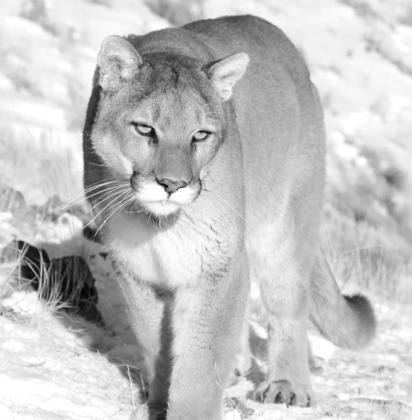
Last week I talked about my son’s encounter with a mountain lion south of town. Mountain lions are one of two apex predators that were in this area prior to Nebraska becoming a state. The scientific name for the mountain lion is “Puma concolor”. “Puma” is Latin and translates as a large cat and “concolor” refers to the fact that it is a uniform color.
Mountain lions or pumas are also called catamounts, cougars, painters and panthers. They are a game species in Nebraska but only a few can be taken. Once, either 19 total lions are killed or 10 female lions are killed, the season is over.
Mountain lions and the other apex predator, the gray wolf, are becoming more and more common.
There are multiple reasons for the increase in their numbers, but the fact is we don’t do large mountain lion or wolf hunts any more. In fact, other than the 19 mountain lions that can be killed, both the cat and the wolf are protected. Add to that the deer and elk populations, which are their main source of food, are huge compared to what they were at the time Gothenburg was founded. Nebraska didn’t even have a deer season until 1945 when 275 were harvested. Last year the harvest was down but still almost 40,000 were legally shot in the state.
Both mountain lions and wolves were the “villains” of the Plains because they do have a habit of killing cattle, sheep, and pigs. If one was sighted or some livestock were killed, a group would get together to go after them. There are a couple of reports in the Gothenburg Independent from 1887 about organizing a hunt to get a large cat that was killing pigs south of the river. The hunt was unsuccessful.
In 1908, a number of calves and a young horse were killed north of Lexington. From the tracks and the condition of the dead animals it was determined the culprit was a mountain lion. The town put together a “posse” and went after the cat. They were unsuccessful and after a couple of tries gave up. A month after the Lexington hunt, a number of cattle were killed on the Redfern Table southwest of Callaway. The farmers and ranchers of the area also organized a hunt.
On the morning of Feb. 5, 1909, 200 men gathered on Redfern Table with the intent of killing the cat.
Reports of the hunt indicate that it was not very well organized and hunters went every which way. They couldn’t find the cat and it is probably a blessing that no one got killed. They couldn’t find the cat because it had moved 13 miles west to the hills near Etna where itwas sighted. Cats can cover a long distance in very little time.
With that much notoriety a lot of “tall tales” about the cat were floated. The paper published a report from one farmer on Redfern Table who claimed the cat crossed his yard and stepped on his scales. He could see the scale and it read 760 pounds. No one believed him then either!
The best fable from Gothenburg’s past about mountain lions comes from Febold Feboldson. He had roped an eagle and was being carried aloft when he let go.
His timing was poor because he fell into a rattlesnake den. He quickly emptied his six-shooter killing six of the snakes and then he jumped away from the den and headed home. He was just north of where the lake now sets, and a mountain lion jumped out of a tree and onto his back. He was able to shed his coat and get a head start as the mountain lion tore up the coat. He ran all the way to his house in Etna with the cat hot on his heels. He got into the house, slammed the door and collapsed into his chair. Unfortunately, the chair broke and in falling to the floor he broke his own leg. The doctor who treated him said that it was fortunate that they didn’t have to shoot him.
*Febold’s story was first published in the Gothenburg Times on Aug. 1, 1928.