
Bayer Learning Center Looking to Harvest Research
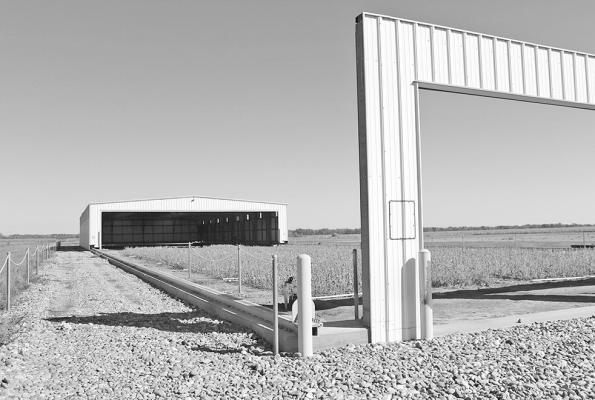
ABOVE: The rainout shelter at the Bayer Learning Center is a building on rails that automatically closes over crops when it senses rainfall. This ensures that plots receive only scheduled irrigation. This year’s research under the shelter focuses on soybeans. BELOW: Demonstration plots at the Bayer Learning Center show how much land it takes to produce a bushel of grain. To the left is the current-day land required, while to the right is the historical amount once needed, highlighting the dramatic gains in yield efficiency over time. (Photos by Krystle Rhoades)
With more than 300 acres dedicated to agricultural research, the Bayer Crop Science Water Utilization Learning Center south of Gothenburg is a hub of innovation for farmers across Nebraska and beyond. The center’s team, led by Manager Mark Reiman, works in small plots to test new products and practices, collecting data that can help growers improve profitability, efficiency, and sustainability.
On the product side, researchers are evaluating potential corn and soybean varieties, with a close eye on challenges like greensnap, crown rot, and other diseases. One of the most anticipated technologies is the Preceon Smart Corn System, a short-statured corn variety that grows to about seven feet tall with ears positioned around 24 inches. The design helps reduce issues with wind and lodging while also making late-season applications more accessible.
“This was developed to help growers with some of the challenges corn sometimes presents,” Reiman said. The plant has a great root system underneath it and can be planted at higher densities because of its stalk strength. Currently, the product is available on a limited basis through Channel and Dekalb.
On the agronomic side, the Learning Center is digging deep into questions about planting dates, weed control, crop rotations, and cover crops.
This year’s planting date trials stretched from mid-March through mid-June. Results from past trials show that soybeans, especially treated seed, can handle earlier planting dates even in cool, wet conditions. Corn, meanwhile, performed best when planted around the first of May. A video of March soybean planting at the center drew more than a million views on social media, reflecting the widespread interest.
Cover crops are another area of focus. At the request of local growers, Bayer tested different termination dates, ranging from two weeks before planting to four weeks after. Initial results suggest that earlier termination improves emergence, though full harvest data is still to come. The center is also in its fifth year of a national, multi-university study looking at the long-term impacts of cover crops.
Crop rotation studies include continuous corn, corn-soybean, and three-crop rotations with wheat. While continuous corn may not always produce the highest yields, Reiman noted that in central Nebraska, it often proves the most profitable thanks to strong corn markets.
One of the most interactive projects underway this year is the TAPS (Testing Ag Performance Solutions) competition, a partnership with the University of Nebraska– Lincoln and Frito-Lay. Ten teams, along with control plots, are making real-time management decisions. These include everything from hybrid and seeding rate to nitrogen timing, irrigation, and even insurance and marketing strategies. A grain quality component, with premiums for white or food-grade corn, adds an extra layer of interest.
Other collaborative projects include irrigation studies using a rainout shelter, where timing of water application is tested. Results are helping farmers become more confident in knowing when stress can be tolerated without hurting yields.
As Bayer looks to the future, the pipeline of products and practices continues to expand. Researchers are testing herbicides targeted at Nebraska’s toughest weeds like Palmer amaranth in the west and waterhemp in the east, as well as new soybean genetics like Vyconic soybeans. Partnerships with UNL and Kansas State University are advancing knowledge in cover crops, fertilization rates, and water management.
Reiman emphasized that the ultimate goal is to give farmers the tools they need to succeed the first time they try a new product or practice. “We want farmers to have a good experience right away,” he said. “If something doesn’t work, it can take a long time before they’re willing to try it again.”
Beyond research, the Learning Center also welcomes a large number of visitors each year for tours, ranging from local farmers to international guests. During these tours, staff showcase unique plots designed to spark conversation, such as demonstrations of how much land it once took to produce a bushel of corn or soybeans compared to today, root digs of the short-statured Preceon hybrids, and side-by-side comparisons of cover crops and termination dates. These interactive stops not only highlight the science behind the studies but also make the research accessible and engaging for anyone who steps onto the plots.
From short-statured corn hybrids to cover crop longevity, the research being done south of Gothenburg is paving the way for the next generation of profitable and sustainable farming. With harvest season approaching, the Bayer Learning Center is looking to harvest research in Gothenburg, turning trial data into insights that can help farmers across the region.