

Blue Jays...They May Not Be For Everyone

MARK M. PEYTON The Village Naturalist
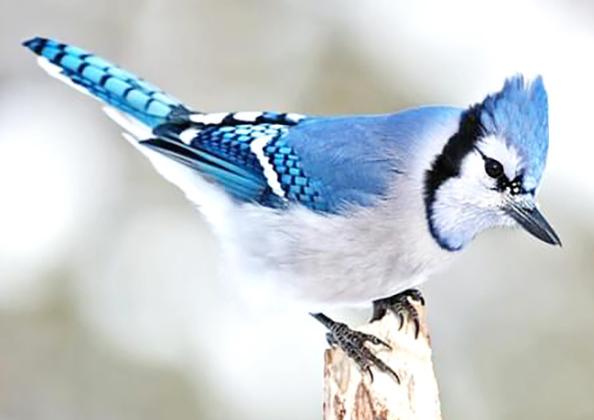
One of my favorite backyard birds is the blue jay. It is large, colorful, and noisy. Also, I can mimic its call fairly well and I have a lot of fun “talking” back and forth with them.
We are actually not “talking”, but more like challenging each other. Through their calls blue jays set up and protect a territory. My calling is a challenge to that territory, so they have to respond. I do have to be careful, however. One spring I was doing the challenge call to a cardinal, and I did it so well he abandoned my yard completely. I guess I won. I don’t want to win with the blue jays; I want them in my yard.
Many people don’t. They point to the aggressive behavior of the jays at the feeder; however, from my observations, they are no more aggressive than the collared doves. Jay-haters also point out that jays will attack the nests of other birds and eat the eggs and chicks. They do, but not that often. One study showed that less than one percent of the diet of jays comes from eggs and bird flesh. Most comes from insects and seeds and at my feeder, peanuts.
I was in Bomgaars and saw a sack of raw peanuts in the shell. On the cover of the sack was a picture of a blue jay with a peanut in its mouth. So, I bought a sack. It was not false advertising. I’ll put out peanuts on my feeder and in no time I’ll have three or four jays flying in, grabbing a peanut and flying out if they don’t just swallow it whole!
Back in the 1880’s blue jays were common “pets”. However, the Migratory Bird Treaty Act of 1918 made keeping them, or basically any other wild bird, a criminal offense. The Treaty not only protected songbirds, it gave the federal government the authority to control duck and goose hunting, something that prior to the Treaty was regulated by each and every state.
For a time, I didn’t have any blue jays to talk to. I blamed it on West Nile Fever. While the disease negatively affected only about 5% of the people who came down with it, it could kill upward to 66% - 100% of some kinds of birds. One of the groups most affected by it was the group that contains jays. Regardless, due to a virus, habitat loss, or pesticides, the populations of blue jays dropped for a few years, but now have begun to rebound. Once again I have multiple jays calling from the yard and eating at the feeder.
One last little tidbit. Blue jays aren’t blue. They are actually brown. The dark pigment melanin is in the middle of the feather with a clear outer covering. When light enters the feather all the different wavelengths are absorbed by the pigment except the brown, which is reflected back out. However, as it passes out of the feather refraction occurs and the wavelength of the brown is “tweaked” and to us it now looks blue!
So enjoy the flash of color in the yard and the loud and raucous calls of one of the smartest birds that utilize our trees.